

Pew Research Center’s Report on Gaming & Gamers

pew-research-center-logo

The Pew Research Center, a nonpartisan research group that conducts polling and demographic research, has released 17 page long report on their findings about Gamers and Gaming. This is an incredibly insightful report for anyone conducting sociological research on current issues in gaming or  seeking the demographic make up of the video game community. It’s a pretty lengthy report, but I’ll try and break down some of the highlights.

The group posed the following questions to a survey of over 2000 Americans.

  • Do you ever play video games on a computer, TV, game console, or portable device like a cellphone? Yes, No, Don’t know, Refuse
  • Do you think this is true for most video games, true for some games but not others, NOT true for most video games, or are you not sure?
    • Video games help develop good problem solving and strategic thinking skills. 
    • Video games are a waste of time.
    • Video games portray women poorly.
    • Video games promote teamwork and communication.
    • Video games portray minority groups poorly.
    • Video games are a better form of entertainment than watching TV.
  • Based on what you know about video games, please tell me if you agree or disagree with the following statements. Agree, Disagree, Don’t Know, Refuse
    • Most people who play video games are men.
    • People who play violent video games are more likely to be violent themselves
  • Some people use the term “gamer” to describe themselves as a fan of gaming or a frequent game-player. Do you think the term “gamer” describes you well, or not? Yes Gamer, No, Not Gamer, Don’t know, Refuse

Additional probing questions were asked about video game causing violence, how racial groups were represented in games, and how video games represent women.

Let’s go over some of their discoveries!

In regards to who plays video games and considers themselves gamers, the report found that only 10% of respondents considered themselves to be gamers, despite nearly half of respondents answering that they play video games.

PI_2015-12-15_gaming-and-gamers_1-01
Respondents in older age brackets were less likely to identify as a gamer

The demographics of gender in gaming is similar to what the ESA reported earlier in the year, but there’s a considerable difference between the number of women and men who identify as gamers, perhaps signalling a disconnect between women and gaming culture.

Why is there such a big difference between people who play games and identify as gamers? It could be that by identifying as a gamer you’re admitting you are a part of a bigger culture that many respondents desire not to be counted upon. The term gamer may carry with it perceived connotations that aren’t appealing to more casual or infrequent consumers.

With regards to the questions regarding video games as  cultural and societal entities, the report found that a good portion of the population believe that video games can provide positive effects.

PI_2015-12-15_gaming-and-gamers_0-02 (1)


I believe this graph is a particularly important one, because it represents a practical and reasonable view of video games within society. As with any medium, video games have a varying range in terms of intellectual and interactive value; some games will be your action fueled titles that don’t challenge you to work out problems, while others can be great sources of cooperative play and brain stimulation. It’s unfortunate that the medium often gets labeled as being only its biggest titles (Call of Duty, Madden, GTA) when there are plenty of games that challenge players to think outside of the box, work together, or take witness to a wonderful tale.

The study also asked questions to respondents in regards to how they perceive violent video games as agent in creating  real world violence.

PI_2015-12-15_gaming-and-gamers_2-02

The majority of respondents did not believe that violent video games lead to violent actions, despite some groups believing they do. It’s clear that younger men and women disagree with the statement, but that the issue is still one that is very much up for discussion and debate among the community.

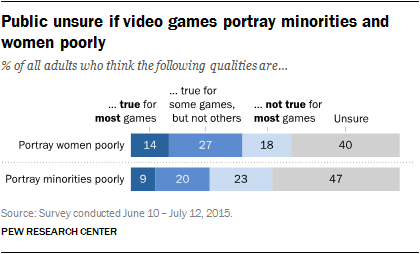
Lastly, we’ll look at the study’s finding on public perception of representation in gaming:
porreay womenminor

This one is a little surprising, as the majority of respondents didn’t choose to weigh in one way or another. It’s clear that more respondents believe that only some games exhibit poor representation of women and minorities, which is a fair statement of video games, but it is alarming that that a healthy portion believe that most games have poor portrayals. This shows that proper representation within video games of women and minorities is an ongoing struggle and that the general population simply do not know about it.

There’s a lot more in the actual report that I highly recommend checking out. This kind of data is rare, but it helps us gain a better understanding of how video games are being viewed in our society and what we need to work on as a community.  For sociologist, such data is invaluable because it gives insight to the social problems existing at the intersection of sociology and video games.

Charts and graphs provided by the  Pew Research Center

For more news and sociological insights, follow us on WordPress or Twitter

twit
Follow us on Twitter @Socialvideogame!


Extra Life: Playing Games To Save Lives

Just a quick one today. I wanted to bring notice to an awesome cause and annual event.

“Extra Life unites thousands of players around the world in a 24 hour gaming marathon to support Children’s Miracle Network Hospitals. Since its inception in 2008, Extra Life has raised more than $14 million for local CMN hospitals.”

Extra-Life is an event that brings together gamers from all over the world to play games in support of the Children’s Miracle Network  of Hospitals.  In collaboration with the ESA, the event  challenges gamers to raise funds through pledges to their gaming marathon.  Participants will attempt to game for a full 24 hours, all for the cause of raising funds for a much deserved cause. Interested gamers can create a fundraising goal for themselves or a team at the Extra Life Website. This years event will take place  next weekend on November 7th, 2015 (Though they’ll take donations for any day!).

Whether you want to participate yourself, watch some streams of participating gamers, donate to the cause, or simply find out more information, head on over to Extra-Life.org for more details.

Such an awesome event just goes to show the amazing good that the gaming community can do when we come together for a righteous cause.

Review: “Video Games The Movie”

Or more appropriately titled “Video Games The Documentary”. Amidst the number of summer movies that were released this summer, this one seemingly went under the radar beneath all of those transmorphers, ninja frogs, and earth defenders. I finally had a chance to sit down and view the film for myself, so I thought I’d share my thoughts on it as both a representation of video game history and culture.

Written and directed by Jeremy Snead and executive produced by Zach Braff, the film was released this summer digitally and in select theaters. The film seeks to give a history of the video game industry and discuss some of the issues concerning it. Coming in at 105 minutes, the movie certainly has a lot to cover in a short amount of time. The result? A disjointed film that takes on more than it can handle. That sounds harsh, but the film is certainly more ambitious than it delivers on. It seemingly has all the elements: great industry professionals ranging from Reggie to Cliffy B, a relatively strong budget, and a wealth of information they could focus on.  Unfortunately the film seems more like a introductory to everything video game related, without any particular focus or time spent on one subject enough to develop it. An introductory to the video game community would be fine, but even as that it misses a lot of beats. Right away anyone who knows anything about video games will notice that the film speeds through over 30 years of history in nearly 10 minutes. It then goes from topic to topic without any real focus, sometimes even returning to add more about certain aspects of video game history that, because of its progression, feels unorganized. This isn’t to say that the other segment beyond history aren’t compelling, in fact the film even touches on how video games are reshaping the way people interact and develop (Hey! that’s what I talk about on here!), but unfortunately these compelling aspects are as rushed as the history provided.The rest of the film touches on some of the major debates in the video game industry, such as the effects of violent video games, but only provides one narrative to them. There’s absolutely no counter points in this documentary, the argument seems to be “video games are great!” but doesn’t allow for the opposition to even chime in.

With plenty of other  better documentaries out there focusing on specific aspects of video game culture or history (Indie Game The Movie, Second Skin, Chasing Ghosts, etc) this one feels like it just took bits and pieces from each and tried to patch it into one film. What this means is that significant chunks of video game history get left out for the sake of other aspects that really could of been left out. If you’re going to tell us the history of the industry: do that! Don’t rush it and then move onto another topic in 20 minutes. WE NEED FOCUS. Also, just as gripe, the film also features interviews from numerous actors and celebreties that really don’t add anything worthwhile besides “LOOK AT THIS CELEB WHO PLAYS GAMES”, especially compared to the industry professionals featured in the film.

“LOOK AT THIS CELEB. SHE PLAYS EM. AIN’T IT COOL!”

In an already short documentary that’s rushing things, despite being 105 minutes, we really don’t need 10 of those minutes given to celebrities talking about something they only vaguely know about.

To sum up, the industry deserves a better representation than this documentary. The film aimed at informing the mass population about the history of video games but will only serve to give them a taste of the real history. For the rest of us who actually anything about the video game industry, don’t waste your time, it may be for the best that this flew under the radar.

New Study Finds Risk Glorifying Games Lead to Deviant Behavior

A recent study suggests that playing mature rated video games may lead to risky, deviant behavior including alcohol use and cigarette smoking. OH HEAVENS!!!

Coming out of Dartmouth College and published this week in the American Psychological Association Journal is a 4-year spanned study that focuses on the effects of violent and mature rated video games on adolescent adults. Are violent video game the gateway drug to worse things, including buying gates and/or drugs? 

The researchers contacted a pool of over 5000 young adults multiple times over the span of 4 years and focused on the three video games “Manhunt”, “Spider-man 2” and “Grand Theft Auto”. Although the respondents fell to less than half of the original 5000, over 2000 subjects were interviewed for the effects of having played one of these three games and continued to play similar risk glorifying games. The researchers found that respondents who played risk glorifying games with an anti-social protagonists (Manhunt and GTA in this case) had reported higher rates of cigarette use, and similar patterns were found for other forms of delinquency than those who reported only have played games with honorable protagonists (Spider-man). 

Honorable.

Jay Hull, the lead researcher, concludes that playing risk glorifying video games increases the likelihood of performing risky actions in the real world. As Hull puts it

“[In video games]They’re not practicing drinking and smoking and risky sex, but what they are practicing is being a less than good person,”.

We’ve seen similar studies where violent video games have been linked to aggression, cheating, and other less honorable behavior, but this might be the first one I’ve seen linked to risky sex..I don’t know how to take that. Likewise, we have seen studies that suggest positive benefits to violent and all video games in general, so the debate seems to be all over the place.The thought behind why this is occurring is that playing violent and risk glorifying games makes kids more willing to take risks in their own life:

“Once a kid is trying one substance, the odds of trying another one go up…The risk starts piling up much faster, and the outcomes for these children get much worse in a hurry.”


Eh…that’s no good. The researcher endorses the use of the ESRB rating system as a form to combat adolescents from getting their hands on these games prematurely.

I don’t know what to think about this study, as it seems pretty well constructed. Obviously the study is reliant on the respondents to tell the truth and gauge their effects, but I can’t think of a more developed way to do so. There may some causes that are effecting the respondents that the study doesn’t take into consideration, such as reasons for why adolescents are getting their hands on violent video games before becoming of age. For example, I can imagine parents who buy their children a spider-man game (regardless of its ESRB rating) may not be the same level of attentiveness as a parent who is okay buy and M rated GT game….but that could be neither here nor there.

The study itself is, unfortunately, only available to those who subscribe to the  APA’s website, but a decent explanation of the study can be found here. 

New Study Finds Positive Effects of Video Games on Social Behavior

This is it guys: A study that directly looks into the effects of video games on social behavior. What could be more relevant to this blog that this study? PROBABLY NOTHING.

Coming out of The University of Oxford, the study explores how time spent playing video games accounts for variation in positive and negative psychosocial adjustment. To do so, the researchers studied a representative sample of 10 to 15 year old children and had them report their daily intake of video games. Essentially, the researchers were trying to see if the number of hours spent playing video games per day had a significant change on one’s adjustment.  I’ll go through the abstract

A pretty interesting hypothesis. Obviously one might assume that playing video games for copious amounts of hours per day would have negative effects on a child, but what about brief periods of time? Let’s hear about these result.

Low levels (<1 hour daily) as well as high levels (>3 hours daily) of game engagement was linked to key indicators of psychosocial adjustment. Low engagement was associated with higher life satisfaction and prosocial behavior and lower externalizing and internalizing problems, whereas the opposite was found for high levels of play. No effects were observed for moderate play levels when compared with non-players.

Huh. The “high levels” of game engagement seem to fall in line with what one might naturally assume; kids playing too much may be antisocial and not well adjusted. However, it’s the low levels effects that are more surprising. The study suggests that playing games in low moderation can actually have positive effects on children. Those prosocial behaviors is sociology speak for saying that kids are more socially adjusted. That’s great news! Video games aren’t making us strange and recluse, well at least if we don’t spend too much time with them. That said, we do have to take into consideration that excessive video game playing was found to be detrimental to one’s social behavior. MODERATION IS KEY MY FRIENDS.

The links between different levels of electronic game engagement and psychosocial adjustment were small (<1.6% of variance) yet statistically significant. Games consistently but not robustly associated with children’s adjustment in both positive and negative ways, findings that inform policy-making as well as future avenues for research in the area.

Hey, that’s a more intelligent way of saying what I just said! I won’t go into the specifics of the study, as the study itself is currently free to read and it’s only 9 pages. It’s great to see more and more studies focusing on the sociological and psychological effects of video games. WE’RE GETTING THERE GUYS. Before I go, a few considerations on the study that I think are important in examining the result.

Considerations: The study is trying to be representative of an entire population, but obviously we can’t make overlapping statements.  Likewise, the low moderation of video games and high moderation of video games can be indicative of something else going on, such as parenting levels and amount of free time. If a child has something else going on in their free times, such as sports or lessons, their amount of hours spent playing video games will considerably lower. We can’t say for sure if it’s correlation without causation; perhaps those who are playing less video games are more well adjusted because of another factor we’re not recording.

Can Video Games Cause You To Hear Sounds After The Game is Off?

I was up late one night trying to get the perfect route in Star Fox 64. I turned off my n64 and retired to my bed. It was then I heard the screams and cries of animals far off in the distance. The sounds of a shot down frog here, the tart responses of a falcon over there; the sounds were more real than my hate for Andross. When I ran to the phone to call for psychiatric help, all I received was this response “DO A BARREL ROLL!”. 

What I was experiencing, in this made up story that would never happen to anyone, is a newly named phenomena called Game Transfer Phenomena. A team coming out Nottingham Trent University is trying to figure out the phenomena of gamers experiencing phantom sounds and noises after turning off their favorite games. These sounds can be anything from music to the sounds of explosions and cries (2SPOOPI3ME) The research suggests that many gamers experience lingering noises and sounds overlaying real life from their games after particularly engrossing play sessions. Having gathered evidence from over 1000 testimonials of gamers who have claimed to witness this phenomena, they claim that nearly 13% of gamers experience this phenomena. Obviously collecting testimonials for forums and from such a low number is only anecdotal, but it is an interesting finding. Earlier in the year we blogged a study that was looking into a similar phenomena that dealt with hallucinations, so there seems to be some backing to the findings. Similar research was apparently done in the mid 90s with the very addictive handheld title “Tetris”.

THERE IS NO NES, ONLY TETRIS.

So should we start expecting to heard phantom banjo strings after playing an engrossing game of Banjo Kazooie? Probably not. It’s really not that unnatural for the brain to replay or responded in different ways after having done any task for an extensive amount of time. If Game Transfer Phenomena is anything, it seems to be the brain dealing with the event from earlier. But what do I know about the brain? Nothing.

What does this have to do with sociology you might ask? Well, not much. But it is interesting that video games may be effecting in ways we never knew they could; biologically and psychologically. Certainly video games are effecting us as a population more than ever.

The Guardian has a better take on this subject, so take a look at their article for real justice to the research. Let us know if you’ve ever heard, seen, or even tasted anything gaming related that shouldn’t have been there. WE WON’T REFER YOU TO A MEDICAL PROFESSIONAL, I SWEAR.

Book Review: “Console Wars” by Blake J. Harris

We’re back in July with a new type of post! A book review! Wow! Due to my slovenly nature and general  disdain for sitting around and reading, I’ve never had the chance to share my thoughts and opinions on a relevant book here on the blog. THAT CHANGES TODAY, JACK!

Why am I doing this? Because I think my opinion matters? Nope. Because I am some sort of scholar? NOT BLOODY LIKELY. The reason I’m presenting this book review is because I think this type of historical narrative is interesting and worth reading for video game and sociology fans. Although Console Wars isn’t a straight historical account or, by any means, a history book, it tells the real life story of the momentous war between Sega and Nintendo. This company war was a pivotal moment in video game history that changed the industry quite a bit. Through understanding video game history perhaps we can better understand where we’re going.

TLDR: VIDEO GAME HISTORY IS IMPORTANT.

“Console Wars” is the latest book by acclaimed author Blake J. Harris, who is best know for the book and film “Moneyball”.  Here’s a small synopsis of the book for those who are unaware:

In 1990, Nintendo had a virtual monopoly on the video game industry. Sega, on the other hand, was just a faltering arcade company with big aspirations and even bigger personalities. But that would all change with the arrival of Tom Kalinske, a man who knew nothing about videogames and everything about fighting uphill battles. His unconventional tactics, combined with the blood, sweat and bold ideas of his renegade employees, transformed Sega and eventually led to a ruthless David-and-Goliath showdown with rival Nintendo.


My thoughts: . Essentially Harris is telling the story of two businesses competing for the video game market. Sounds boring, right? Fortunately, Harris has the exceptional ability of making the mundane palatable. By focusing on specific individuals (primarily Tom Kalinske) Harris makes the narrative less about the historic business tactics that occurred and more about the personal struggle to adjust to mounting demands of working in multinational companies and keeping ahead in a sky rocketing industry. In doing so, the history is broken down in such a way that it feels compelling and almost episodic; you feel for the characters in a way that a traditional historical account wouldn’t be able to convey. These are interesting characters to say the least; they’re trailblazers and huge figures in the video game history  whom many know little to nothing about. Like Moneyball, the book is more about the people than it is products. Likewise, the war between Sega and Nintendo is compelling enough to push the book forward

Half way through the book one would assume that Sega is the David of the story, going against the villain Nintendo. However, the book is never unfair to Nintendo or overly sympathetic to Sega. Obviously, Nintendo and Sega are no longer the same companies they were during the 90s, so it’s important to remember them for the companies they once were; Nintendo really did rule the industry with a power glove. Likewise, Sega is depicted as a company at war with itself, which in many led to its inevitable loss of power in the industry. These are interesting insights about these two companies that people may not know. By the end of the book, you may have a different perspective about these two companies.

Sociological Content wise it’s interesting, but shouldn’t be taken for more than a narrative. Console Wars is in no way a research worthy historical account, but it provides very interesting insight into the culture of the video game industry and the community. The story is an account of the 90s and it in many ways reflects the mindsets and beliefs held by the majority in those years. Video games were a different beast in those days and the book gives readers a unique look back that gamers today may have forgotten or not known about.. 

In all, I’d recommend the book to any gamer looking to learn a little more about the history of video games. I considered myself pretty knowledgeable, especially when it came to the console war between Sega and Nintendo, but the book really takes the reader behind the scenes of these two massive companies in a way that other account do not. It’s honestly a compelling book, even if you’re not directly interested in it for the video game knowledge. It is a lengthy read, but it’s quite worth the read.

“DA DUH DUN!”

Of course, you can also wait for the upcoming film adaptation produced by Seth Rogen and Evan Goldberg. I’m sure it won’t completely translate to film, but if Moneyball is any indication of how Harris translates his books to film it should at least be worth the watch.  That’s it. Book review over. Please give me a passing grade, teach!  Maybe I’ll do more book reviews when I read more books.

Other resources!

Buy Console Wars on Amazon!

Back In My Play Podcast Interview with Blake J. Harris


NPR’s “All Things Considered” piece on Gaming Diversity

NPR’s “All Things Considered” piece on Gaming Diversity and Video Game Violence

NPR’s “All Things Considered” has a new piece on video game diversity that reflects on their experience at this years E3. For those who don’t listen to ATC, it’s a segment show on NPR in which the correspondents go out and explore different things. This week Arun Rath reflects on his experience at E3. Spoiler alert: He didn’t spend his entire time there playing the new Battlefield.

Listen to the piece on their website or read the transcipt, it’s less than 7 minutes and an interesting insight from someone who clearly is a foreigner to the gaming community. He raises some issues we already know about, but are important nonetheless. His major focus in the lack of diversity presented in E3 among presenters and protagonist, which is true and fair. However, using E3 as a temperature for the community as a whole isn’t pragmatic. Despite this, he does an interesting enough job of bringing the issue to his listeners, a populace of people who probably don’t know much In addition, he brings up is  the amount of violent video games revealed/shown at this E3 and the amount of sequels at the show. These are fair reflections, but they may not necessarily reflect the entirety of E3. He glances over a lot of the new and unique things coming from specific developers and instead focuses on how the Oculus Rift is the next “revolution” in gaming. EH….I don’t want to comment on what I think about the OR, but I think it’s fair to say that  Rath didn’t get the full scope of E3 in the article.

It is fair to say that E3 has become dominated by violent video games. This graph, created by user timetokill on Neogaf, shows the breakdown of reveals of games that focus on shooting:

GAMERS JUST WANNA SHOOT

This generations focus on shooters is interesting, but that’s a subject for another day. E3 has always been about appealing to the console gaming masses, and this year’s was no different. With the gaming demographic expanding, hopefully in future years we’ll see the console population diversify as well. Until then, big shows like E3 are still going to be directed at their main audience: males who love shooters.

At least Nintendo is doing something….not shooting?

New Tropes VS. Women In Gaming Video: Women as Background Decoration Part 1

Anita Sarkeesian has released a new installment in her Tropes Vs. Women in Gaming video series that explores women as decorative objects in gaming. Her videos tend to be controversial amongst the gaming community, but I think she does great work to exposure a lot of the sexism and bias in the gaming community. Others may say “LOLWHATEVER”, to which I would reply “touche” .  Warning, some content in the video can be a little graphic and NSFW. Anyways, here’s a description of the video from  The Feminist Frequency website.

“In this episode we explore the Women as Background Decoration trope which is the subset of largely insignificant non-playable female characters whose sexuality or victimhood is exploited as a way to infuse edgy, gritty or racy flavoring into game worlds. These sexually objectified female bodies are designed to function as environmental texture while titillating presumed straight male players. Sometimes they’re created to be glorified furniture but they are frequently programmed as minimally interactive sex objects to be used and abused.

Sexual objectification is the practice of treating or representing a human being as a thing or mere instrument to be used for another’s sexual purposes. Sexually objectified women are valued primarily for their bodies, or body parts, which are presented as existing for the pleasure and gratification of others.”

Let me know what your stance on these videos are. Please  no “SHE STUPID. SHE NO NOTHING BOUT VIDAJ GYMES”.

Father’s Day In Gaming

Video games are full of dads. Dads over here, dads over there. And why not? Games reflect society and guess what society has a lot of? Dads. Thus, in honor of father’s day, I thought we’d look at some the best and worst fathers in video gaming history. I’ve decided to break these dads into three categories: Bad dads, Sad dads, and Rad Dads.

BAD DADS

Dads sometimes like to be bad. Could be rebellion against the feelings of being tied down by a family, or pent up anger over their favorite sports team losing the big match (THE DENVER SLIM SLAMS GOT ROBBED, HUH HONEY!?), regardless there’s a lot of bad dads out there in video games.

-Heihachi (Tekken franchise)

Kazuya Mishima, my son, this is where you die. I will see you in hell!

Fighting games seem to have a lot of bad dads, but none seem worse than Heihachi from the Tekken franchise. I know the Tekken universe is a little insane, but let’s put that all aside and look at the terrible father that is Heihachi. Let’s look at some of the fatherly things hes done over the span of the series.

  • Throws his son into a ravine and forces his son to make a deal with the devil.
  • Throws his son into an active volcano.
  • Adopts a second child to fight his biological son.
  • Enters a tournament to beat up his son and adopted son.
  • Betrays his grandson to experiment on him.
  • Shoots his grandson into space. INTO SPACE.

So there you have it. His son wants him dead, his adopted son wants him dead, and even his grandson wants him dead. That said, he has a pretty sweet bear that loves the hell out of him.

-The King of the Cosmos (Katamari Series)

“It is not your fault. It is our fault for believing in you.”

Now you may be saying ‘THE KING OF THE COSMO IS THE GREATEST!”, and yes you’d be right. However, The King of The Cosmos is a terrible father. He’s constantly destroying the cosmos on accident on either drunken binges or haphazard tennis games that make black holes and then has the nerve to make his son clean up the mess. That would be all fine and dandy, but he doesn’t give his son the credit he deserves. He constantly talking crap about all of prince’s work making stars and then takes the credit for making the stars. WHAT THE HELL!? Nothing is good enough for this bad dad, not even creating an entire sun.  He’s just a lazy, glory hogging, careless, tyrant.

Honorable mentions:

  • Kratos: Killing your wife and kids, even if being tricked by a God, is still pretty bad.

SAD DADS

Let’s face it. There’s an odd amount of sad dads in video games. This could be because video games inherently make dads sad because they remind them of their forgotten youth, or because game developers use childrens’ death as a motive for plot progression and more developed characters more often than Mario saves Peach.

Joel (The Last of Us)

READ NO FURTHER IF DON’T WANT SPOILERS!

Joel is a mix of a sad and rad dad. The game starts with Joel desperately trying to protect his daughter from the onslaught of a mysterious outbreak. He tries hard, and in his attempt you see how much he loves his daughter even as she lays dieing in his arms. 20 years later he’s a sad, hardened dad. Unlike a lot of sad dads who sit around looking at pictures of their children, this sad dad has become the ultimate survivor. Of course, throughout the game he bonds with Ellie, a young girl that is thrust into his life, and shows that he still has the fatherly nature in him. DON’T BE SO SAD, SAD DAD.

END SPOILERS.

 Bowser (Super Mario Series)

Bowser isn’t a sad dad in the normal sense of a sad dad; you’ll never see him weep into a swansons tv dinner or grow a slovenly beard over missing his kids, but he is a tragic dad. Why? Because he’s a constant failure to himself and his kid/s. All Bowser ever wants to do is capture Princess Peach so she can be the mother of his kids. He’s desperate for a female role model in his kids life. Unfortunately he’s always foiled by Mario and his goons, but that doesn’t stop him from trying. Time and time again he fails, only to rise up again and again. He’s so tragic that his own kids have disowned him (See the Koopa Kids) and his only remaining son is now deranged in his own right. It’s Okay Bowser… It aint easy being king.

Honorable mentions: 

-Doctor Light: Doesn’t have kids, so he build some. They have to save the world and almost die with each step they take.

RAD DADS

Some dads are pretty rad. Hopefully your life is filled with Rad dads; dads who go to your ballet lessons and wait in the car listening to talk radio without batting an eye. Dads who give their Sundays up to take you to some kids party you’ll realize you hate years later. These are the rad dads that make up certain video games.

Octodad

Octodad is a pretty rad dad. Why? It’s not only because he’s an octopus disguising as a human man to live a normal dad life of taking care of a wife and kids, it’s because he’s damn good at it. Contrary to naysayers who say “Octopuses can’t be good human dads!” or “He’d be as good at being a dad as an octopus could possibly be” Octodad blows all presumptions away by being an awesome dad regardless of being an octopus or not. Not only that, he does it while trying not to raise suspicion that he is an octopus; how many dads out there have to do that?

-Big Daddy (Bioshock Series)

Not all dads have blood relations to those they’re dads to, and Big Daddy is a great representation of that. What’s there to say that hasn’t been said about these massive, monstrous, creature dads in  metal suits whose sole purpose are to protect the hideous and evil little children that dwell in a post apocalyptic underwater city? Regardless of what’s been said, i’ll say it again: these dads are rad. Like mad sports dads who fly off the handle when their kids get fouled in a game, Big Daddies protect their young at all costs, and that’s a damn honorable trait.

Honorable mentions:

Hagger (Final Fight): He’s a the mayor of the city. That doesn’t mean he won’t kick some ass to save his daughter.


There’s some dads for ya. Let me know who your favorite video game dads are and why they deserve the respect of their peers and unsupportive children.