Report on the Status of Teens’ Use of Technology in Social Life

The PEW Research Group has recently released their 2nd  of 3 reports on “Teens, Technology &  Friendships”. PEW, which describes themselves as  “a nonpartisan fact tank that informs the public about the issues, attitudes and trends shaping America and the world”,  has conducted extensive research to academically confirm something we all probably know: Teenagers are using technology  to maintain social relationships.

thispos

If you’re mind has just been blown, please take sometime to compose yourself and in the near future you might want to reconnect with society (Google has self-driving cars now, don’t be scared). The report itself is actually pretty insightful and explores how teenagers use video games in their social life more thoroughly than any study I have seen previously. It’s obviously isn’t going to be ground breaking conclusions, but a big part of sociology is academically documenting and observing trends in society.

There’s a lot of information we could go over, most of which dealing with how teens are using social media sites and apps like Twitter, Instagram, and Facebook to create and maintain social ties, but for the sake of only going over what most pertinently concerns this blog we’ll only be delving into the report as it concerns video games. LET’S JUMP IN:

“52% of all teens spend time with friends playing video games; 13% play with friends daily.”

In line with what the ESA reported on video game usage for 2015, this statistic doesn’t surprise me. Gamers in general are becoming more and more social, so it’s only natural that you’d see teenagers take advantage of this as well. Games like World of Warcraft and Halo are cited as specific games that have been used as tools for socialization within teen social groups.

“Overall, 72% of teens ages 13 to 17 play video games on a computer, game console or portable device. Fully 84% of boys play video games, significantly higher than the 59% of girls who play games. Playing video games is not necessarily a solitary activity; teens frequently play video games with others. Teen gamers play games with others in person (83%) and online (75%), and they play games with friends they know in person (89%) and friends they know only online (54%). They also play online with others who are not friends (52%).

This is a little confusing to read because of all the numbers. The way to read these numbers is the percentage of respondents that fell into that group. Don’t try and add them up, as individuals may fall into multiple categories (for example, a teen may respond  that he plays online regularly with friends he met online AND plays with people who are not friends).

What’s interesting here is to examine just how much video games have pervaded our culture. On whole 42%* of Americans play video games regularly, so for 72% of teenagers to play video games  regularly one can hypothesize that the number of Americans who play games regularly will probably continue to go up year to year. Likewise, just the sheer number of teens playing online is remarkable. 10 years ago that amount probably would have been halved. It’s not all that surprising, what with all major consoles being online  and the majority of AAA games having some sort of online mode, but it’s dazzling to see for someone who grew up in an era in which video games were mostly a solitary activity.

  • -38% of all teen boys share their gaming handle as one of the first three pieces of information exchanged when they meet someone they would like to be friends with; just 7% of girls share a gaming handle when meeting new friends.

  • -Of teens who have met a friend online, 57% of boys have made a friend playing video games. That amounts to 34% of all teenage boys ages 13 to 17.

These two are particularly interesting, just because these aren’t the type of statistics most studies will look into.  It makes sense that a good portion of teens making friends online would do so in a video games, as it’s a common ground for people to meet and share something they’re both interested in.  If anything, I’m more interested what the relationships of people meeting in others  online grounds would be; forums potentially have the same effect, but social media sites are more of an oddity in my mind. Regardless, it shows that technology is being used in various ways to strengthen and even create relationships.

When playing games with others online, many teen gamers (especially boys) connect with their fellow players via voice connections in order to engage in collaboration, conversation and trash-talking. Among boys who play games with others online, fully 71% use voice connections to engage with other players (this compares with just 28% of girls who play in networked environments).

This one is the statistic I found to be the most interesting, as one might be able surmise a bigger problem at work.  With 59% of girls playing video games, it’s surprising that only 28% responded that they play with voice communications. In a interview by Kotaku, a lead author of the report concluded that this means only about 9% of girls playing video games are using voice communication in online games. Why the low number? The study unfortunately does not go into why this may be, but if I had to guess I would say they may be a mix of practical and troubling reasons for the community. I don’t want to make assumptions, but it wouldn’t surprise me if one of the reasons found were because teens girls had negative experiences when playing online with others. I’ll leave it there.

This chart is exemplifies this gender difference between how male and females are using video game communities. For boys, video games are being used as social outlets in the same way text messaging and social media is being used, which is something one might not automatically assume.

There’s much more in depth analysis in the report itself, which can be found here in its entirety. The grand take way to the entire report is that technology isn’t causing the social relationships of teens to diminish. Yes, teens aren’t connecting the same way they did 20 years ago, but they’re still connecting and the social bonds they create aren’t any less real or solid. Technology, in many ways, is augmenting the ways we connect with others and even allowing us to reach groups and people that we wouldn’t otherwise be able to connect with.  So, the next time you see a teen on their phone don’t scoff or dream of the “good ol’ days”, just realize that society advances and restructures how we socialize.

*Data from ESA 2015 Report

Follow us on Twitter!

Review: “Double Fine Adventure!”

Not all documentaries are created equal, especially when it comes to ones focusing on the world of gaming. It’s rare that a video game documentary is something I can recommend, as many don’t do the subject matter justice (See my review of “Video Games the Movie”). However, occasionally we’re graced with some really excellent film making the tackles the subject in an interesting and well thought out way.  2 Player Production’s Double Fine Adventure is that rare film.  I say film, but it’s actually closer to a show as the piece was originally broken up into 20 episodes that were released as the game’s production went on. As a whole, DFA chronicles the development of the Double Fine point and click adventure game “The Broken Age”. From the game’s initial Kickstarter all the way until the game ships, you see the whole process on film.

broken-age-walkthrough

What sets DFA apart from other films/series of its type is just how true it is to the development process of a video game. It’s not all glitz and glamour kids, making a video game is a difficult process that has emotional highs and lows. Movies like “Indie Game The Movie” focused on this as well, but DFA has the unique perspective of showing the ins and outs of an established video game company that works and lives game to game. Despite being a fairly known development company, Double Fine isn’t Naughty Dog, Nintendo, or Capcom; they’re a considerably small company that has a lot of the same struggles that independent developers face.

To give a little background on the subject matter, Double Fine Productions was founded in 2000 by ex-Lucasarts developer Tim Schafer, who created many of the company’s amazing point and click adventure titles such as Grim Fandango and Full Throttle.  Based in San Francisco the company has developed several cult hits including Psychonauts, Brutal Legend, and Costume Quest, but had not returned to the point and click genre until the announcement of the Kickstarter campaign. The first episode chronicles the initial Kickstarter that funded the game, which raised over 3 million dollars over the course of one month.

From there, the piece shows viewers how a game goes from inception to completion from stage to stage. This is where the piece becomes essential for anyone interested in video game design or the academia of gaming. Each episodes chronicles a stage of the video game process, for example there’s an entire episode where the team brings in art consultants to draw out facets of the worlds to motivate and help Tim visualize the world he’s trying to create. Slowly but surely you can see the game take form, which is even more interesting if you have already played through “The Broken Age”.  Along the way the documentary introduces you to key members of the Double Fine team, whom the viewer really gets to know and empathize with through the course of the years that the documentary was made. When the team fails to miss a deadline the viewer feels the emotional weight that the team themselves are feeling, as over the course of the episodes you become more and more invested in this game being developed.  Likewise, when Tim first previews the game to a crowd of fans you feel the emotional high that Tim and his team felt in that moment; start to finish, the team at 2 Player Productions do an amazing job of documenting the humanside of game development.

This type of documentary may not have worked with all developers, but Double Fine is home to such a devoted and creative group of individuals that you create a relationship with them over time. The main man himself, Tim Schafer, really exemplifies this more so than anyone else; you get a very good sense of just how much he truly loves gaming (especially the point and click adventure genre) and the fans that have placed so much support in him and his staff.  It’s an underdog story through an through, as the film shows how a small development company can make a successful in a genre that was deemed financially dead by the gaming industry. As I mentioned in my pieces on Kickstarter and Crowdsourcing websites, games like the Broken Age show that the conventional methods of getting a game developed are no longer the only options: We all now have a say in what games we want to see developed and made.

To Summarize: “Double Fine Adventure” is a must see for anyone interested in the gaming industry. It may very well be the most true to life look of what it’s like to develop a game in this current gaming climate. Shot beautifully and with care, the film will change your perception of what goes into the games we play. Go check it out, and while you’re at it play the Broken Age. It’s also a terrific game.

You can pay to see the whole film here, or you can watch all of the episodes without bonus features on Double Fine’s Youtube channel.

Follow us on Twitter!

Operation Supply Drop: A Charity Making A Difference Through Games

A quick one today about Operation Supply Drop, a charity organization that is changing the lives of veterans and currently serving men and women in arms.

Before I write anything I should note that Venturebeat has a great piece about how the charity is helping Veterans with life after service that you should read instead whatever I’m going to write here.

Still with me? Alright, I’ll give you a little information about the organization myself. OSD’s mission is pretty simple:  to “Make Fun Where There is None”. By providing games and entertainment to currently deployed men and women, the charity looks to make a difference in the lives of those that are activity trying to make a difference around the world. Giving these men and women video games is giving them an escape or diversion from what is often a lonely and hard situation. Games can brighten their days in countless ways, from giving them a piece of their regular lives back to connecting with friends and family from across the world. It’s pretty damn awesome what giving someone a video game can do.

OSD also does significant work for those who have returned from war:  the charity facilitates online and offline communities for veterans that have returned home to give them a network of friends and fellow veterans, creates networks for veterans seeking to get into the video game industry, provides financial support and scholarships for veterans to attend school for programming and game design, and more.  Pretty amazing stuff coming from people who first hand experienced how gaming changed their lives during deployment.

Organizations like OSD show that games be used as tools for social change. Everyday we’re finding out more utilities for gaming, ones that we wouldn’t had imagine years ago. Video games are truly augmenting our daily lives in more ways than ever before.

twit
Follow us on Twitter!

How Riot Games Cut Down Online Harassment in League of Legends

Video game communities really are interesting microcosms; small societies that have their own ways of life and governance.  A major part of sociology is examining how social institutions(Religion, Government, Law Enforcement, Social Clubs, etc.) reproduce societal beliefs. Video games are a relatively new social institution, as for a long time their social components were reliant on other forms of society, such as the creation of social clubs or social ties with others. With the advent of the internet and online communities, video games have arose as a social institution of their own; a formative social structure that brings people together  and replicates what it means to be apart of society. For example, if a person had no outside knowledge of the world, video games may be able to give that person a sense of the morals and beliefs of the greater society.

Even games like Grand Theft Auto can teach about what is acceptable and unacceptable behavior in a society, as if you break the law in the game cops and bystanders will react to your actions. There’s morals and lessons to learn in about any game, but where sociology really finds its footing is in the online communities that have formed in and around specific games.

Why do I bring up all of this nonsense? It’s because the development staff over at Riot Games have created a governing system in their insanely popular game, League of Legends, that exemplifies this idea of video games as a social institution.  Jeffery Lin, a lead game designer for the team, wrote a really insightful piece  for Recode.net.

Let’s go over some of it.

But that led to a big question: How do you introduce structure and governance into a society that didn’t have one before? The answer wasn’t as simple as abolishing anonymity. Privacy has become increasingly important online as data becomes more widely available, and numerous studies have shown that anonymity is not the strongest cause of online toxicity. While anonymity can be a catalyst for online toxicity, we focused on the more powerful factor of whether or not there are consequences (both negative and positive) for behaviors.

The team had been seeing a problem of online harassment for sometime; problems of racism, sexism, and homophobia were among the community’s issues. To curve the amount of harassment, the team at Riot created something called the Tribunal System. The system effectively creates  case files for the community to view and judge whether they deem them acceptable or unacceptable. If an action is deemed unacceptable by the majority of members, then players will be given warnings and then an eventual ban if they persist.

As a result of these governance systems changing online cultural norms, incidences of homophobia, sexism and racism in League of Legends have fallen to a combined 2 percent of all games. Verbal abuse has dropped by more than 40 percent, and 91.6 percent of negative players change their act and never commit another offense after just one reported penalty.

That’s pretty remarkable, and a clear indicator that online communities can benefit from a form of organized structure. By putting it up to the majority of gamers, you’re probably not going to see bans given out for trivial things like gloating or leaving a game early.

However, the system isn’t just to penalize people, as there is also a system in place for rewarding gamers who effect the game positively.

In League of Legends, we’re now able to deliver feedback to players in near-real-time. Every single time a player “reports” another player in the game for a negative act, it informs the machine-learning system. Every time a player “honors” another player in the game for a positive act, it also trains the machine-learning system. As soon as we detect these behaviors in-game, we can deliver the appropriate consequence, whether it is a customized penalty or an incentive. Critically, players in the society are driving the decisions behind the machine-learning feedback system — their votes determine what is considered acceptable behavior in this online society.

I’m just going over what you can read in the article itself, but I think it’s important to point out how meaningful this is to the study of video games as social institutions.  Games can now have their own system of government, penal systems, and other facets of society that we probably would have never guessed would appear in a video games. They’re mirroring society, yes, but they’re also expanding and changing what it means to live in society. Video games have the unique ability to augment the parts of society that we deem  important or interesting; we can potentially create more dynamic and interesting societies than even our own.

Time’s “Everything You Know About Boys and Video Games Is Wrong”

A new Time’s piece is claiming that everything you know about boys and video games is wrong. I don’t know if exclusive knowledge on either subject is false, but you may as well throw away all of your beliefs about both boys and video games. Rosalind Wiseman, whose work you probably have experienced without even knowing it (Her book was the basis for the movie “Mean Girls” for example) explores how middle school and highschool boys view sexism in video games. Should we care? Is this study worth your time?  “Forget Everything You Know About Research Studies”

The interest in the subject matter began when she started noticing her students being annoyed by overly sexualized characters in their handheld games (Candy Crush 3 features some real bosomy candy bars). She specifically mentions “Game of War” which is an incredibly popular mobile game that has, as its mascot, Kate Upton dressed in a outfit very inappropriate for the battlefield. Thus, she decided to team with her research group to survey kids from across the country to get their perspective on sexism in the video game industry. She surveyed  more than 1,400 middle and high school students with a questionnaire that asked them to agree or disagree with certain statements relating to sexism and objectification of females in gaming. The results, she claims, will stun you (They probably wont).

To preface, I want talk about the presumption the article takes: it assumes that young boys are drawn to games that features women in scantily clad clothing and feature a male protagonist.  This assumption is an odd one, as teenagers and middle school students aren’t the target audience for games that feature these characters. Obviously puberty is difficult and young boys hormone are insane, but that doesn’t mean they want sexism or objectified women in all aspects of their lives. If anything,  I would argue that young men have more shame when it comes to characters being over sexed because they  feel embarrassed to play games with on-screen characters they don’t want their family seeing. Adults, on the other hand, could care or less, which is why they are the target audience for games with more explicit characters. As such, I don’t think a results that claim that boys are “more progressive” than we believe is a stunning new finding.

Terrible anecdote time: From my own personal experience, I wouldn’t have wanted to play or had games around that featured sexist characters.  For example when I was a teenager, I wasn’t particularly proud of playing Final Fantasy X-2 at points. It’s a perfectly harmless game that features the games heroines in ridiculous outfits, but otherwise it’s actually a pretty solid game. Being a fan of the original I naturally wanted to play the sequel, but was embarrassed at times because some of the silly and ridiculous scenarios and outfits the game would place the characters in. I also knew others who chose not to play the game as a result (Probably more so because it looks like a girls game, but regardless). FFX-2 is also a very low offending game, so I can’t imagine how others would feel with more explicit characters and games.

Nevertheless, back to the claims:

Boys believe female characters are treated too often as sex objects

47% of middle school boys agreed or strongly agreed, and 61% of high school boys agreed or strongly agreed. “If women are objectified like this it defeats the entire purpose of fighting,” Theo, an eighth-grader who loves playing Mortal Kombat, told us. “I would respect the [female] character more for having some dignity.”

This one is the that’s garnering the most debate. It’s a difficult thing asking middle-school children about objectification, as it’s a complex concept that a lot of them may not understand. That said, the results aren’t as overwhelmingly positive as piece seems to make them out to be.  If only 47% of middle schoolers and 61% of highschoolers agreed with the statement that women are being objectified it leaves a healthy portion of kids that either don’t agree or have no particular opinion on the matter.  I have other issues with the research method (or lack there of in terms of description), but we’ll come back to those issues.

Both boys and girls aren’t more likely to play a game based on the gender of the protagonist

70% of girls said it doesn’t matter and 78% of boys said it doesn’t matter. Interestingly, boys care less about playing as a male character as they age and girls care more about playing as a female one.

With more female characters in gaming becoming the norm, it’s positive to see this response.  I have a sneaking suspicion that this question was influenced by the wording however, as the results are almost too overwhelmingly in favor of not caring whether the protagonist is male of female. Likewise, I’ll discuss that a little more in a bit.

Girls play a variety of game genres

26% played first-person shooter games like Call of Duty and HALO, 36% played role-playing games like Skyrim and Grand Theft Auto, and 17% played sports games like FIFA and Madden. (19% did not play games, compared to 3% of boys.)

This one if the most straightforward, and represents a lot of the data that the ESA reported on with their yearly findings.

The survey isn’t currently available and I haven’t been able to find a copy of it. If I had a better sense of what was asked I could make a more informed decision on this study, but as of right now it’s all conjecture. I bring up that I’m unsure of the answers, as the statements seem like they could have been led in some way. The way someone phrases a question can dramatically effect the way someone answers it. For example, a questionnaire that asks “Do you care if the video game protagonist is your same gender” is a radically different question than ” Who do you prefer to play as: Male, Female, or it doesn’t matter”. This isn’t to suggest that the results would be different, but if you’re going to make bold claims that claims everything we know is wrong, you should have a strong methodology to back up your research. This takes us to the surveys bigger issue:

roswise

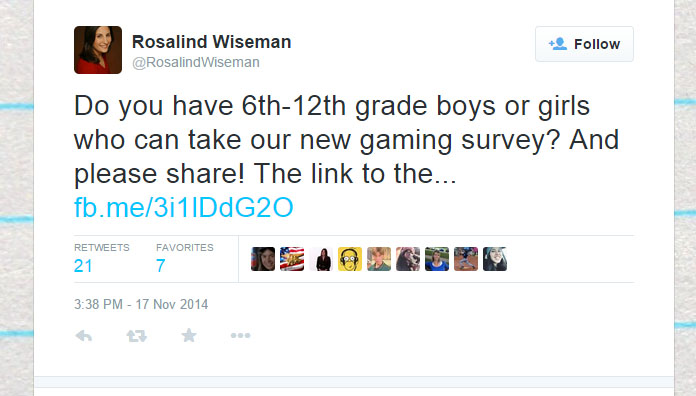
The gaming community is questioning some of the research methods, as it seems that a portion of the respondents were distributed via twitter and using Survey Monkey.  That right there is a red flag, as one’s twitter following is clearly not representative of a general population and  survey monkey in no way  prevents people from lying about their age to take the survey.  These two facts alone are grounds to throw the whole thing into question, as it’s just not proper science.

It’s a shame, as this is an interesting question and one that, with a proper methodology, could potentially yield similar results. If video Games  are to become an academic medium then we must adhere to tried and true forms of scientific methodology. Faux science isn’t going to cut it.

Games That Make a Difference: Never Alone

makadif1

Some games are rare. Not rare in a sense that they are hard to find or procure, but rare in the sense that they don’t fit the mold of the traditional video game. Never Alone  (Also known as Kishima Innitchuna) is a rare game. Thematically, the game is one that is seemingly a phenomenon.

Never Alone is the first game I’ve featured in the category that I’ve actually played completely through, primarily due to it being a game that is easily accessible to all gamers (It was even free with Playstation Plus for a limited time). I know I’m a little late on the subject matter, as the game has been out for over a year, but even a year later it is a remarkable entity in gaming history. Gameplay wise, it’s a decent enough game that features some beautiful visuals, but overall it isn’t something that’s going to revolutionize the genre. In fact, if you’re playing the game  alone it can actually be somewhat frustrating at points (Never Alone can be described as the preferred play method as well). This frustration lessens when you have someone next to you playing as the second character in the game, as it cuts down downtime between moving characters and makes the overall experience more enjoyable. Like many cooperative platformers, it requires a good amount of communication and team work to progress, but that’s not the reason why it’s a special game or anything out of the ordinary. Where the game really shines is its ability to be more than simply a passive experience of play: The game serves as an educational tool and means of cultural preservation.

Upper One Games, which identifies as the first indigenous-owned video game developer and publisher in US history, has created a game that stands as a cultural representation of a culture and people that  is increasingly disappearing and being dissolved. The game is very much so a cultural survey of the the Iñupiat, an Alaskian Native population, who are a people that are trying to adapt to the changes brought on by the advancement of technology. Why are we seeing traditions and cultural heritages disappear in this modern age? Historians and academics believe it’s a combination of globalization and cultural blending. One can imagine that a culture that has historically only relied on oral and written tradition as a means of passing on knowledge being opened up the the greater  world in a dramatic way, via the internet, would certainly effect the way people learn and view the world. While globalization comes with some amazing new opportunity, it can have the side-effect of dispersing certain ways of life and traditions because of the influence of this previously untapped outside world. Thus, certain cultural traditions are disappearing in a time in which even the number of individuals that may identify with these groups  are decreasing as well.  With this in mind, the staff at Upper One Games had the idea of creating a game that would serve as a way of preserving and passing on traditions and information about  the Iñupiat culture to both people inside their community and to the wider world, and with that Never Alone was created.

The game itself features the story of a young Alaskan native named Nuna who finds her village destroyed by a raging blizzard. With the aid of a white fox, Nuna goes on a journey to find the source of the blizzard in an attempt to put an end to it. During her journey, she travels through many myths and tales of the Iñupiat tradition, each with some beautifully rendered graphics that stay true to the culture’s history. The story comes alive as more than simply a game’s plot, as the developers  allow the myths and legends of the Inupiat people to become characters and experiences in the game. Even the harsh weather of the Alaskan winter becomes a character as the duo struggle to press on against it. Alone, these facets of the games create a detail world, but its in the game’s additional content that the developers connects and illuminate the world of Never Alone to the grander world outside.  They do so in 22 optional mini documentary pieces that unlock as the player progresses through the game.

These “cultural insights”  are presented on different facets of the rich culture of the Iñupiat people, delivered directly by members of the Iñupiat community.  In doing so, the story of  Nuna and her artic fox becomes more than just the story of a video game, it becomes a painted illustration of culture. This blend of game design, documentary, and storytelling allows for Never Alone to take on the form of modern day oral tradition in a unique and detailed way. These insights are an fun and interactive way of blending education and gaming, one that more developers  should consider implementing to expand the lore of their in-game worlds (real or not).

Never Alone shows that video games can be more than just a way to waste some time; they can be tools of education, a digital display of one’s cultural history, and a means of preserving traditions of the past. In creating Never Alone, Upper One games created a new form of oral history, one that has the potential to reach much grander audiences than ever before. Like generations before them, the team and community behind Never Alone has created a historical artifact for generations to come to experience. Judging by the success of the game and it’s subsequent DLC, it seems that Never Alone has succeeded in its mission: The world is now much more aware of the  Iñupiat people and its community. Video games can be more than what we previously imagined and we’re only beginning to see how they can be utilize to expand our experience.

Never Alone is available on all Major Platforms including PS4, X1, Wii U, and Steam. If it sounds like something you’d might want to try, I’d recommend giving it a go; your gaming time will be well spent.

Do you have a game you think has historical or social importance? Let me know! I’d love to explore some more games.

Crowdfunding and Shenmue 3: Where We Are and What It Means

A couple years back I wrote an article about how Crowdfunding was increasingly a route for independent developers to use to jump start and create their passion products. I asked the question as to when we would see bigger developers and franchises turn towards crowdfunding sites like Kickstarter and GoFundMe to revive beloved franchises that didn’t receive the financial response they needed to secure sequels. Well, that’s happened. The dream is real, and Shenmue 3 is now something that will be made.

qO727H4I could gush on for hours on why I am excited about Shenmue 3, but I won’t. The game’s announcement, however, has some historical importance I believe should be discussed. The game represents a shift in the gaming industry that may change how certain developers gain funds and support for titles. Yu Suzuki tentatively “announced” Shenmue 3 at the Sony E3 conference to gauge support for the game. Obviously support and interest was  there, as the 2 million goal was reached in less than 10 hours.  Once reached, backers (specifically Sony) agreed to contribute support to the game to ensure its development. Not only was it the fastest funded video game project yet, it looks like it may be the highest funded one when it concludes.

Why does this matter to sociology? With games like Shenmue 3, Yooka-Laylee, and the Mighty Number 9, developers have options to create games that may not otherwise  be made. Not only that, but with fans being a major force in backing the game the game really becomes by the fans for the fans. Yu Suzuki has stated that he will involve fans in numerous ways  during the development, including even potentially having major donors be characters or voices inside the game. This form of development creates a unique exchange between developer and fans and links the two more prominently than ever before. In doing so, this relationship between fans and developers creates a community around the game that may lead to a strengthening in development and experience. This community and exchange between developers and fans is a sociologically interesting one because it dramatically changes how we view and interact with the game’s we play.  Games and gaming developers are no longer entities that exist outside of the reach of gamers; we are all now apart of the process.Obviously we’re at the start of this process, but the prospects are quite exciting.

Beyond development, Shenmue 3 proves that a niche crowd in gaming, one that is vocal and proactive enough, can make their desires reality. That’s an important shift in gaming, one that can inspire other passion projects or long awaited sequels to see the light of day.

So, let’s start out on this new journey of an era in which no game’s development is out of the question.

SUPPORT THE KICKSTARTER HERE!

WATCH THE ANNOUNCEMENT VIDEO HERE!

Study Suggest 23% of Kids Consider Playing Video Games a Form of Physical Activity

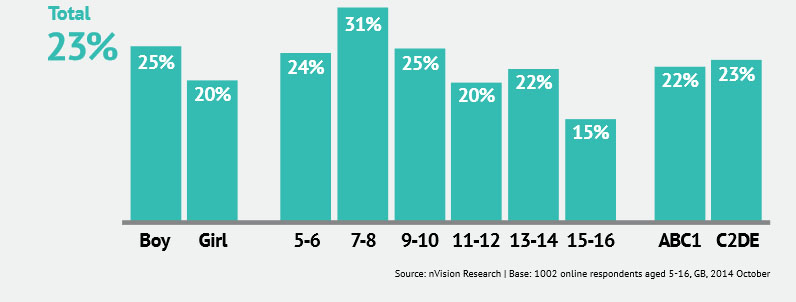
The Youth Sports Trust, a group the does advocacy for physical education and physical well-being, has compiled a report on the status of today’s youth. The report is pretty well done, with a lot of insights about how technology is changing the way kids socialize, view physical activity, and interact with technology in physical activity, but there’s one piece of data that is grabbing more headlines than others. The report suggests that 23% of kids believe that playing video games is a form of physical activity.

Should we panic and throw out all video game consoles and computers for fear that our kids will inevitably become blobs? Probably not. Let’s consider what this data is actually suggesting, whether it’s an accurate claim, and how they might have come to this conclusion

physicalact

23% of kids believe video games can be a form of physical activity. This would be a bigger issue if this was 1995, but kids today have a much wider experience when it comes to playing their games.  If you’re in this age range of 5-16, you’re household more than likely has a console that has some sort of motion control component to it. The Wii itself was a     cultural phenomenon, so it’s unlikely that kids today haven’t seen or played a game that requires physical motion. With this in mind, it’s not insane to see where kids are making this claim from; some games require physical motion, they must be a form physical activity.

IT’S JUST LIKE MOVING!

Whether using the Kinect or Wii can be considered a “form of physical activity” is a subject up for debate for adults, but they undeniably require physical activity. Kids aren’t going to be able to define the difference between an activity specifically meant for physical fitness and an activity that simply requires physical activity; they’re kids, let’s not be silly.

Another consideration is that the poll was conducted using a likert scale, meaning they give the respondents the options between “agree, strongly agree, neither agree or disagree, disagree, or strongly disagree”. These types of polls are useful, but can lead to polling errors and over simplification of data.

Let’s think about it. If you’re a 7 year old child and you’re ask if you think games are a physical activity you’re going to draw on your knowledge of video games. You’re most likely thinking some games have physical activity involved (Wii Sports, Star Wars Kinect, etc), but the majority do not (Minecraft, Skylanders, etc). With a Likert scale, “Agree” and “Disagree” most closely relate to “Some, but not all”, but kids with some knowledge of physically active video games will probably tend on the side of agree, even if they only marginally agree with the statement. Thus we have a problem: likert scales lump people who only marginally agree in with people who agree to a greater extent, which wouldn’t be a problem if we weren’t making bold statements based on these scales.  It’s a minor nuisance in data collecting, but important nonetheless.

Also, some kids just like to pick the silliest options.

So maybe we shouldn’t be flabbergasted that video games are being considered physical activity; maybe they’re just evolving to become one. With VR on the way, it’s certainly looking that physical activity and gaming are tied together.

TLDR: GET OFF THESE KIDS’ BACKS.

It’s unfortunate that this singular question is the one sparking headlines and debate, because the report itself has a lot of interesting insights that are being overlooked as a result. With more and more public funding being cut to programs that support physical fitness and with the rise of technology being more closely tied to social and physical development, it’s important for us to understand and research how we can adapt to these new trends.

Madden 16 Will Add Female Fans to Their In-Game crowds

“We’re here to recognize the amazing milestone in gaming that EA Sports has undertaken with this year’s Madden 16. In a gaming climate where diversity and representation is an ongoing struggle, this brave gaming company has shown that they are willing to take a stand on the side of equality. I’m sure you’ve already heard about their tremendous feat, but it’s worth mentioning once again: This year’s Madden 16 will feature female fans in the in-game crowd. Let that sink in for a moment. So brave. So daring.” – Second Lady of the United States, Jill Biden*

Battling for the biggest non-news of the year, EA Sports felt it was necessary to make an announcement that the upcoming Madden 16 would feature female fans in the in-game crowds. You may be scratching your heads and asking “Why the hell haven’t there been female fans in the crowds in previous games?”. The answer, of course, is because only men like fruttttbrawwwll.

That’s a lot of dudes!

After EA Sports made waves  (They didn’t make waves) by announcing that they would feature  female soccer teams to the next FIFA game, the Madden developer stated that “We’re excited about FIFA adding women players, but we wouldn’t let them steal all the thunder…So we’ve added women to our crowds”. Great job, thunder achieved.

This is a non-addition to something that should have already been in place. Why they have chosen to not include female fans in the crowds in previous games is more news that them adding them in. It’s an odd announcement on the back of a somewhat less trivial announcement. STEP OF YOUR ANNOUNCEMENT NEWS EA.

I’m going to save EA some time and make some future trivial announcements for them:

-The next Battlefield Game will have 5 colors of camouflage!

-The next Sims game will let your character work a blue collar job!

-The next Plants Vs. Zombies game will feature zombies that were originally from minority groups!

*Not an actual quote, because why would it be?

Games That Make A Difference: Zoo U

makadif1
Wow, what a smart and creative title! – No one

It’s time to talk about games, but we’re not going to talk about any ol’ ordinary games; we’re going to talk about games that make a difference. These posts are going to be about games that have some sort of sociological significance; be it in the way they change the industry or in the way they change those that play them. So let’s dive in with our first game:

ZOO U

Zoo me? Zoo U.  Developed by 3C institute, Zoo U is an interactive game that seeks to help kids develop social and emotional skills. It does this by tracking and accessing players  skills as they play through the game. Players are given common day social situations that a child may come across in class, and then gives them options as to how to progress in those situation, all in a simulated virtual school setting. In doing so, it assess initial social skills and then assesses them as they progress to help instructors and parents gauge their child’s development.  The game focuses on six core social skills to : impulse control, empathy, initiation, communication, cooperation, and emotion regulation.

Warning: Your child may come out of the experience with expectations of wild animals living and playing inside schools.

Why does Zoo U make a difference? I haven’t played the game myself, but the game is reported to have positive effects on the social and emotional well being of the kids that play it. Developing social skills at a young age is important to a child’s  emotional well being,  their academic development, and their success in making friends.. Games like Zoo U can give a leg up to children that may be having a difficult time developing these skills by making the learning process fun and engaging. Likewise, at an early age repetition is important in the development of skills (It’s why they have you do your times tables so many times) but in social situations you may not always get that repetition that often need. Video games bridge that gap, as it gives the child unlimited opportunities to interact communicate with their in game peers.

Games like Zoo U certainly aren’t the first wave of educational games, but they’re some of the first to be targeted at specific skills. We can think back to our own youths and the educational games we may have played. Games like Zoo U are building off their the first wave of educational games in meaningful and focused ways. We’ll have to see how this efforts effect their participants in the long run.

Check out Zoo U’s website

That sound a bit like an advertisement, but I do think that games that are directed at developing social skills can be huge help in assisting kids who may have problems developing social or emotional skills. This stuff is important, as they really are the building blocks to being a emotional and socially healthy adult. We can all use some help sometimes, so why not make it a bit more fun with some Vidja Guymmeessssss

Now excuse me while I pitch Bioware a dark and gritty version of the game that gives you branching paths that all lead to the same silly ending.