Nintendo at E3: More Gender inclusion (Is that a female Link!?)

Nintendo’s digital event went live this morning, and they showed off an array of games including the first footage of the upcoming Zelda game, Smash Brothers, and Yoshi title.

Palutena_06102014021538

As we discussed during last year’s E3, Nintendo has really been upping the amount of female protagonists in their recent titles. They are continuing this trend this year by announcing several games with playable protagonists who are female.

-Hyrule Warriors currently features 3 of 4 female characters as protagonists, including Impa, Midna, and Zelda.

-More female characters in Smash brothers than ever before, including new entries such as Palutena, Wii-Fit Trainer, and a female villager.

ZVO

However, the biggest news seems to be coming out of one of Nintendo’s biggest franchise: The Legend of Zelda. While unconfirmed, it seems as though we may be a Link whose gender is up for customization. I…can’t tell. Link has a ponytail and is certainly looking a lot more feminine than in previous entries. It could honestly go either way: is Link becoming more androgynous, or can you change the character’s gender? With the news of the gaming being more open world, it’s not unlikely that Link will be more changeable than ever before. Guess we’ll find out as more details about the game come out.


2014 Nielsen Report on Video Game Consumption

2014 Nielsen Report on Video Game Consumption

The folks over at the Nielsen Report (You know, the people who tell you that your favorite show will probably get canceled) have released their 2014 report on video game consumption. The Nielsen report is more of a general observation on video game consumption that other outlets. For a more detailed look, I recommend checking out the ESA’s 2014 report on video game consumption.

So what do these guys named Niels (I assume everyone that compiles this data is named Niel) have to say about video game consumption?

#1: People are spending more time playing video games!

Up from 2012 and 2011, gamers are putting more hours into gaming each week. This would mean that the average gamer puts a little less than an hour of gaming in a day. Neato.  That’s an extra hour of Pokeymans than last year! This increase could very well be due to the increase of popularity in mobile games, which enables players to play on the go.

#2: The number of console gamers who also play on mobiles is increasing!

This isn’t that surprising. As smart-phones and tablets become more and more common place so does the amount of gamers playing games on these devices. You’re not going to not playing games on a mobile device you already have, right? I mean that would be insanity…so of course I will devote days of my life to “Candy Crush” like the electronic heroine that it is.

#3: Mobile Games/Tablets are increasingly growing in the amount of gaming time played!

Although the number of hours spent on gaming is increasing, much of the share of the time is being given to mobile and tablet games. However, console games are still the norm and still make up the majority of gaming time spent. Likewise, newer consoles (Wii U/Xbox One/ PS4) are gradually building audiences while last generation consoles still make up the majority. We’ll probably see this percentages shift in the next two years, but as of this year many gamers have yet to make the jump to next gen.

That’s pretty much all the Niels have to say. Not real revelations, but interesting nonetheless. It’s pretty nifty to see in numbers the increase in popularity that video games are having. As these numbers grow, it becomes increasingly more pertinent that we evaluate all the sociological issues around video games. If only someone would do that…instead of what we’re doing here, which only amounts to nonsense.

NOW ONTO E3 WHERE ALL OF OUR DREAMS AND NIGHTMARE WILL COME TRUE!

New Study Says “Violent Video Games May Increase Moral Sensitivity”

Remember when your parents told you that violent video games and violent movies would desensitize you to violence? A study coming out of the University of Texas Austin and Michigan State University suggest that your parents were big fat liars….Well, maybe.

The study finds that doing heinous acts in video games increased the players sensitivity towards those acts in normal life. So, you car-jack a car or murder a hooker in GTA and you may be more sensitive about car-jacking and hooker murdering in real life. Super!

“We found that after a subject played a violent video game, they felt guilt and that guilt was associated with greater sensitivity toward the two particular domains they violated — those of care/harm and fairness/reciprocity,”

THAT’S WHAT I JUST SAID LESS INTELLIGENTLY. The study, which will be published in an upcoming “Cyberpsychology, Behavior and Social Networking” claims that we should all rethink the effects of violent video games.

Mortal Kombat taught me how severe one’s torso from their body.

I’ll wait to see the actual piece, but this seems like a common thread: Group A will claim negative about violent video games and then weeks later Group B will claim something positive about violent video games. There’s no definitive answer on the violent video game subject (AND THAT MAKES ME RAGE, AS I WAS JUST PLAYING MORTAL KOMBAT)

“Our findings suggest that emotional experiences evoked by media exposure can increase the intuitive foundations upon which human beings make moral judgments… This is particularly relevant for video-game play, where habitual engagement with that media is the norm for a small, but considerably important group of users.”

That, of course, would go against many who claim that violent video games are the downfall of our society and that they caused the second world war.  We’ll keep an eye out for the actual research and report back on its methodology, so stay tuned….you 4 readers!

Check out the University of Buffalo’s piece on the study!

Libertarism and Video Games: A match made in heaven? Poll Says So.

http://www.gamespot.com/articles/video-games-and-libertarianism-go-hand-in-hand-poll-finds/1100-6419549/


A Ron Paul video game already exist. No “Take Nap” bonus level included.

A poll coming out of the magazine “Reason”, a libertarianism magazine, finds that there might be a correlation between libertarian beliefs and playing video games. Should gamers be flocking to the polls for Rand Paul, or is this all just bogus. WHO IS TO KNOW, PROBABLY NOT GOVERNMENT.

I won’t delve to much into the poll itself, but the poll was administrated by the magazine to gamers to get their beliefs about fiances and consumerism. The poll found that gamers had leaning towards libertarian beliefs, despite the majority of gamers classifying themselves as liberal.

“If there’s any one trend to take away from a poll looking at gamers it’s that gamers don’t like to be told what to do with their lives,…Again, they may describe themselves as liberal, but they do not like government policies that control individual life choices, like what products they can purchase or consume. Video games are all about making choices, right? That’s one mentality that does carry over in real life.”

Hey, ok. Having not seen the actual poll questions, I can’t comment on how slanted the questions were, but certainly one has to take a poll from a libertarian magazine making claims about libertarianism with a major grain of salt. Saying that this poll may have a political slant is a huge understatement. That said, the claims of “not liking being told what to do”  as an indicative  of libertarian beliefs in gamers is a little hard to chew. Even the most liberal individual probably won’t say they “like being told what to do” in regards to their consumer habits. That statement is about as libertarian as donkeys (Get it, because…they’re…democratic).

Some of the “libertarian beliefs” gamers have are:

A significantly larger percentage of gamers than non-gamers believed that they should be allowed to buy caffeinated energy drinks, play violent video games, and gamble in online poker games. They also supported legalizing marijuana and 3D printed guns in greater numbers. The biggest difference was gamers’ support for using Bitcoin as a currency. 55 percent of gamers were in favor compared to 30 percent among non-gamers.

I…don’t even know where to pick this apart. It’s pretty silly trying to relate most of these beliefs to a political philosophy , but of course that is what this magazine is trying to do. It would only be more absurd if the claims were “Libertarians drink mountain dew and so do COD gamers! REVELATION!?”  Again, having not seen the actual poll itself, I’m only commenting on the purposed results of the poll, but it seems that the magazine is drawing correlation where there isn’t really much. It’s our job as good sociologist and gamers to question these sorts of pieces, as having the backing of gamers is something many groups may want; They want to play with power.

That’s all for now. Silly poll, silly conclusions. I should have probably put that up front to save you time from reading this articles. TRICKED YA SUCKER.

Update: Nintendo Reaffirms Stance on Same-Sex Relationships in Tomodachi Life


Last year Nintendo responded to a glitch found in their popular Japanese 3ds Title “Tomodachi Collection” that allowed players to enter into same-sex relationships with a patch. We discussed the issue a bit on here and it was admittedly a strange case, as the glitch enabled occurrences such as male Miis becoming pregnant and only allowing for same-sex male relationships.  After the patch was released the response to Nintendo’s action seemed to die down, however the argument has since resurfaced upon Nintendo announcing the game (Tomodachi Life) for North America and Europe. Since then an online petition and miiverse community movement called “Miiquality” have been created to move Nintendo to allow for same-sex relationships in the NA/EU versions of the game. Community members have taken to Miiverse, twitter, facebook and most social media outlets to let Nintendo know of their desires. This week, a representative of Nintendo responded with this statement:

“Nintendo never intended to make any form of social commentary with the launch of Tomodachi Life…The relationship options in the game represent a playful alternate world rather than a real-life simulation ….We hope that all of our fans will see that Tomodachi Life was intended to be a whimsical and quirky game, and that we were absolutely not trying to provide social commentary.”

TLDR: “We’re not trying to be progressive here”.  Unfortunately this is just another strike in Nintendo’s list of things they’re behind the times on.  This could have been a momentous move for Nintendo to show that they are progressive, but instead they chose to show that they are behind the times once again. With other family oriented companies like Disney making strides in representing the LBGT community, it’s unfortunate that Nintendo isn’t following suit. Even from a financial standpoint, the publicity and buzz Nintendo could have created by responding to requests positively could have extremely helped sales of the upcoming. Instead, they’ve only served to anger and disappoint a growing population of their community. They’ve handled this situation like they’ve handled to Wii U  (HAHAHAHAH GET IT. BADLY)

It’s a bizarre world in Tomodachi Life

Then again…Maybe a bizarre, strange experience like Tomodachi life isn’t the best place for Nintendo to make such a stance….or any statement. Regardless, Nintendo needs to step into the modern day.

UPDATE EVEN MORE!!

 Nintendo has released an official apology regarding the subject:

We apologize for disappointing many people by failing to include same-sex relationships in Tomodachi Life. Unfortunately, it is not possible for us to change this game’s design, and such a significant development change can’t be accomplished with a post-ship patch. At Nintendo, dedication has always meant going beyond the games to promote a sense of community, and to share a spirit of fun and joy. We are committed to advancing our longtime company values of fun and entertainment for everyone. We pledge that if we create a next installment in the Tomodachi series, we will strive to design a game-play experience from the ground up that is more inclusive, and better represents all players.

Meh. Seems reasonable enough. To be fair, the original patch that Nintendo released for the Japanese version wasn’t removing the ability to have same sex relationships, it was a patch released to fix a glitch that occurred when players brought over a Mii from another 3ds that inadvertently marks those miis as the wrong gender. They were REALLY trying to not take a stance either way. Perhaps this movement may see the fruits of its labor in future installments of the game.

Pollster Finds Correlation Between Having Tattoos and Video Games, Sociologists say “Duh”

Poll finds big changes in American life

Pollsters Find a Correlation: Tattoos and Video Games

Video_Game_Tattoos_13

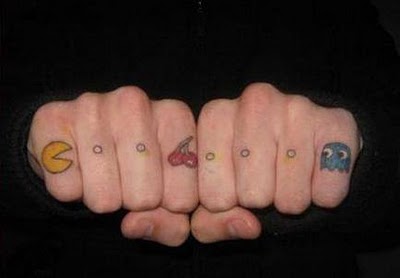
This week the Wall Street Journal revealed their results of a poll gauging American lifestyles and habits. Among other rising trends in young adults, video games and tattoos have stood out as prominent habits in American lifestyle. The rise of video games isn’t surprising since, as we’ve discussed on this blog before, the percentage of Americans playing video games is growing more and more each year. However, the poll has found a overlap in the number of people playing video games and having tattoos.

Wait, there may be gamers that tattoos? SHOCKING.

Pollsters Bill McInturff, and Fred Yang found considerable overlap between tattoo households and people who said they play videogames, though they didn’t know exactly why that is beyond both videogames and tattoos holding more appeal to “younger, downscale respondents.”

You don’t need a doctorate in Sociology to begin to hypothesize why there’s an overlap between the tatted and gamers, it’s fairly obvious that the driving force is that both mediums appeal to a younger demographic. However, as the population of Americans who play video games has grown beyond 50%, the correlation between Video Games and anything begins to weaken. If the majority of the population are playing video games, then it’s reasonable to make the prediction that many niche groups (In this example, people with tattoos) will probably be doing that activity as well. Thus, it’s not really news for “young group A” to have a correlation with playing video games, as that’s the majority of the population for young adults. MORE WORDS TRYING TO EXPLAIN THINGS.

Now that video games are gradually becoming melded into American sociolization, isn’t it time that we start to accurately discussing and evaluating the medium for the increasing part of society that it is? Let’s stop being surprised that people are playing video games. Hopefully we’re doing our own part here to increase the awareness about the study  and discussion of video games.

That looks painful…

More Video Game Tattoos

ESA: 2014 Facts and Stats About Video Game Consumption

The Entertainment Software Association has released their annual report about video game consumption and demographics. For those new to the ESA, these statistics are gathered by the foremost collectors of video game demographics and stats in the industry. Here is the entire report for 2014 in PDF Form. Give it a read, it’s quick and very easy to read.

The ESA is super helpful for anyone interested in video games and sociology, as they do all the grunt work to figure out gaming population and trends.

Last year I posted the 2013’s report in some dept, but let’s see what has changed, stayed the same, or is new.

whos playing

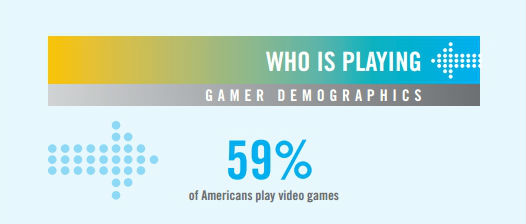
The number of people playing video games has increased! Compared to last year, the percentage of people playing video games has increased from 58% to 59%. That means more and more gamers are becoming the norm.

digi

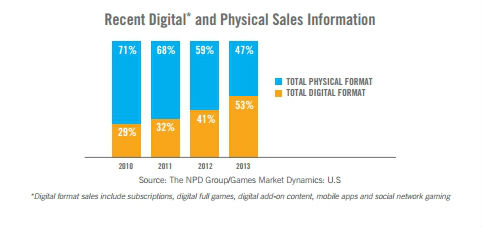
Digital sale of video games have surpassed physical sales of video games. What does this mean? This means that less physical games were sold in 2013 than digital video games. This is majorly due to the increase of popularity of mobile apps and online digital purchases, but it is interesting nonetheless. Now that it is easier to download games online over avenues such as the app store or Steam it is becoming more and more apart of the norm.

Who is the average gamer?

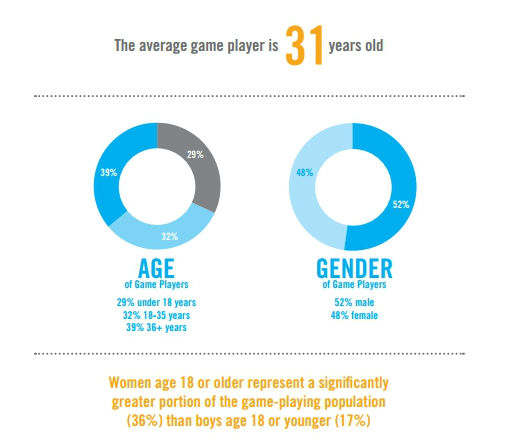
Although the demographics aren’t that different from last year, it is still worth looking into the average gamer:

whois

The industry is steadily growing to be a more adult one, with AAA titles mainly being made for gamers 16+. That said your average gamer is still an adult male, but more and more women are becoming apart of the gaming sphere; they’re really closing in! This could be in part due to the increase of popular mobile games aimed and women and girls, but also due to women becoming PC and Console gamers as well.

That’s all I’ll say about this years findings for right now, but please do go and read the ESA’s finding for 2014: they have an array of information from demographics to sales. I’ll try and edit or expand on these demographics and stats in the near future.

ESA Website


The Sociology of Video Games’ 1st Anniversary

Today marks one year since I registered The Sociology of Video Games

The cake is a lie. No cake was baked.

It’s been a year of sociologically relevant news, looking into racist games, and failed attempts at humor.  I can’t thank everyone who has supported the blog over this past year, you’ve help keep me motivated to post and share my interest in sociology and video games. I do hope the blog has been worthwhile for those who have subscribed and commented. With your help the blog has really taken off: we’re the first thing that pops up when you search “sociology video games” on google, and we’ve seen links to articles and post spring up in all sorts of awesome places.

The responses and feedback I have received has made up keeping this blog all the more worthwhile. I’m humbled by many of the responses I have received, and I’m glad so many people have found the blog to be worthwhile.

What does the future hold?

I intend to keep building the blog. I would love to see the blog become a place for people interested in sociology and video games to come, discuss, and share resources. In the near future I intend to make the transition to a full fledged website/blog that will provide outlet for discussion, outside contribution of articles or posts, and resources for those interested in sociology and video games.  I’m continuously trying to expand the blogs presence, so hopefully one day we’ll see these goals come to fruition.

I would love to hear from other fans of sociology and video games. Although this blog has been a solo effort, it would be great to share this blog and subject matter with those who are interested. So please let me know if there’s anything you’d like to contribute, share, or see more.

Things The Blog will Introduce in Year 2 (One of these is real!)

tails_out7tsm– A sidekick blog character that appeals to a younger audience and has more appendices than normal!

-6 readable authors, 5 of which are just clones of the original.

-Rideable dinosaurs!

-8 New Robot masters.

-More than 150 new articles, even though you were told in the previous year that only 150 articles in total existed. (Honestly, how hard did they even look?)

– More articles and silliness.

Wired – Nintendo’s New Key To Creativity: More Women

http://www.wired.com/2014/03/animal-crossing-director/?mbid=social_fb

Wired has a new article this weekend about Nintendo’s new strategy for creativity in their development process: adding more women to their development teams.

The article notes the success of Animal Crossing New Leaf, which has been  an all around success for Nintendo. It’s a great game for doing mundane tasks and filling the empty void in your life with fake furniture and appeasing talking animals. More remarkably:

Since its release in 2013, New Leaf has sold 7.38 million copies worldwide, and is credited by Nintendo with helping the handheld 3DS system reach 42.74 million units sold. It also boasts another striking statistic: Nearly half of the Animal Crossing: New Leaf game development team was female. And according to Eguchi and Kyogoku, the two are far from unrelated. Indeed, they believe that the diversity of their team was crucial to their game’s success.

However the bigger story is that they intend to further this success with applying the same belief to future games, which means we may see more female development staff on future Nintendo games.

I won’t go too much farther than that, as you should go read the article, but it is an important step in making Nintendo a more diverse company. If Nintendo, who has been slow to adapt to change in many parts, can begin to diversify, then perhaps we’ll begin to see it throughout the industry. And that, my friends, will be a great thing.

For More Reading:

Is Nintendo Being More Gender Inclusive?

New Study Suggest Video Games May Be Enforcing Racism

They did it everyone. They found the link between playing video games like Kirby and being a bigot…Well, not really. However, A recent study coming out of Ohio State University has found some interesting findings regarding racism and video games. This study may make your reconsider your next gaming choices.

In Saints Row you can be a thug of any race or gender! Or not, I haven’t played it.

Published in the journal Social Psychological and Personality Science the study questioned what  happens when white video game players find themselves playing as black video game characters in violent video games. The first experiment had 120 white students play the violent video game Saints Row. Participants were randomly given either a white protagonist or a black protagonist in the game. Furthermore, players were given one of two missions – break out of prison or go to a chapel without harming others. After each play sessions participants were given the Implicit Association Test (IAT) to reveal any hidden biases they may have had by having participants link white and black faces to either negative or positive categories. The results found that players that were using black avatars were more likely to link negative categories to black faces than those who used white avatars. Similarly, it was found that players who played the more violent mission were more likely to agree with the statement “It’s really a matter of some people not trying hard enough; if blacks would only try harder they could be just as well off as whites”.  Yeesh, that’s harsh.

We’re getting into some scary findings here kiddos, but it doesn’t stop there. A second experiment was conducted to further these findings. In this follow up experiment, 141 more white college students were asked playing either WWE Smackdown vs. RAW 2010 or Fight Night Round 4. As in the previous experiment, participants were assigned either a white or black avatar and then given the IAT to measure their biases. However, after each play sessions participants had the opportunity to give their unseen partner (presumably their opponent) a punishment in the way of hot sauce, which the participants knew they disliked. The results found were inline with those of the previous experiment; players who played as black avatars were more likely to associate negative categories with black faces than those who played as white characters. In regards to the hot sauce portion of the experiment, players who played as black avatars gave their partners 115% more hot sauce than those who played as white avatars. Clearly, something about playing as black avatars makes white players want to dish out some hot sauce.

What this suggests is that something about playing as black avatar characters, especially in violent scenarios, reinforces negative stereotypes about the black community in white video game players and makes them more aggressive towards others. While it’s a general perspective to believe that more minority characters will make general audiences more empathetic to people of colors, this study suggests that negative and unbalanced minority characters may only fuel further racism and bias. Regardless of this study’s findings or not, clearly there is a lack of balanced and progressive minority characters in the video game industry.

gtav-screenshot1

One thing the study does not do is offer reasons why this may occur, other than their go-to embedded racism. Embedded racism may be the perpetrator, but one must consider that there may be something more at work. It would be interesting if the same experiments would be done with a control group of only black video game players: would the same results be found or would the results be flipped. One consideration the study does not offer is disassociation: players could potentially be more likely to be more aggressive when they have a further distance between themselves and their character. Not relating to their character on race may be making players relate less, and thus become more aggressive and more likely to act out. Of course this doesn’t offer a solution as to why they would be biased towards racial stereotypes, but it’s a consideration.

This study tells us something that we already know: negative characters lead to negative attitudes and actions. Playing as a violent killer is negative, regardless of the race of the character or player. I’m not suggest we pacify or censor our games, but instead me more conscious of the media we’re consuming and how it effects us. It often is more fun to be violent in a video game than not, but perhaps we should only be giving our gaming palettes opportunity to be violent.