
Pew Research Center’s Report on Gaming & Gamers

pew-research-center-logo

The Pew Research Center, a nonpartisan research group that conducts polling and demographic research, has released 17 page long report on their findings about Gamers and Gaming. This is an incredibly insightful report for anyone conducting sociological research on current issues in gaming or  seeking the demographic make up of the video game community. It’s a pretty lengthy report, but I’ll try and break down some of the highlights.

The group posed the following questions to a survey of over 2000 Americans.

  • Do you ever play video games on a computer, TV, game console, or portable device like a cellphone? Yes, No, Don’t know, Refuse
  • Do you think this is true for most video games, true for some games but not others, NOT true for most video games, or are you not sure?
    • Video games help develop good problem solving and strategic thinking skills. 
    • Video games are a waste of time.
    • Video games portray women poorly.
    • Video games promote teamwork and communication.
    • Video games portray minority groups poorly.
    • Video games are a better form of entertainment than watching TV.
  • Based on what you know about video games, please tell me if you agree or disagree with the following statements. Agree, Disagree, Don’t Know, Refuse
    • Most people who play video games are men.
    • People who play violent video games are more likely to be violent themselves
  • Some people use the term “gamer” to describe themselves as a fan of gaming or a frequent game-player. Do you think the term “gamer” describes you well, or not? Yes Gamer, No, Not Gamer, Don’t know, Refuse

Additional probing questions were asked about video game causing violence, how racial groups were represented in games, and how video games represent women.

Let’s go over some of their discoveries!

In regards to who plays video games and considers themselves gamers, the report found that only 10% of respondents considered themselves to be gamers, despite nearly half of respondents answering that they play video games.

PI_2015-12-15_gaming-and-gamers_1-01
Respondents in older age brackets were less likely to identify as a gamer

The demographics of gender in gaming is similar to what the ESA reported earlier in the year, but there’s a considerable difference between the number of women and men who identify as gamers, perhaps signalling a disconnect between women and gaming culture.

Why is there such a big difference between people who play games and identify as gamers? It could be that by identifying as a gamer you’re admitting you are a part of a bigger culture that many respondents desire not to be counted upon. The term gamer may carry with it perceived connotations that aren’t appealing to more casual or infrequent consumers.

With regards to the questions regarding video games as  cultural and societal entities, the report found that a good portion of the population believe that video games can provide positive effects.

PI_2015-12-15_gaming-and-gamers_0-02 (1)


I believe this graph is a particularly important one, because it represents a practical and reasonable view of video games within society. As with any medium, video games have a varying range in terms of intellectual and interactive value; some games will be your action fueled titles that don’t challenge you to work out problems, while others can be great sources of cooperative play and brain stimulation. It’s unfortunate that the medium often gets labeled as being only its biggest titles (Call of Duty, Madden, GTA) when there are plenty of games that challenge players to think outside of the box, work together, or take witness to a wonderful tale.

The study also asked questions to respondents in regards to how they perceive violent video games as agent in creating  real world violence.

PI_2015-12-15_gaming-and-gamers_2-02

The majority of respondents did not believe that violent video games lead to violent actions, despite some groups believing they do. It’s clear that younger men and women disagree with the statement, but that the issue is still one that is very much up for discussion and debate among the community.

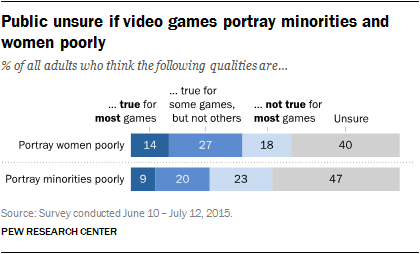
Lastly, we’ll look at the study’s finding on public perception of representation in gaming:
porreay womenminor

This one is a little surprising, as the majority of respondents didn’t choose to weigh in one way or another. It’s clear that more respondents believe that only some games exhibit poor representation of women and minorities, which is a fair statement of video games, but it is alarming that that a healthy portion believe that most games have poor portrayals. This shows that proper representation within video games of women and minorities is an ongoing struggle and that the general population simply do not know about it.

There’s a lot more in the actual report that I highly recommend checking out. This kind of data is rare, but it helps us gain a better understanding of how video games are being viewed in our society and what we need to work on as a community.  For sociologist, such data is invaluable because it gives insight to the social problems existing at the intersection of sociology and video games.

Charts and graphs provided by the  Pew Research Center

For more news and sociological insights, follow us on WordPress or Twitter

twit
Follow us on Twitter @Socialvideogame!


ESA: Essential Facts About Gamers and Politics

banner

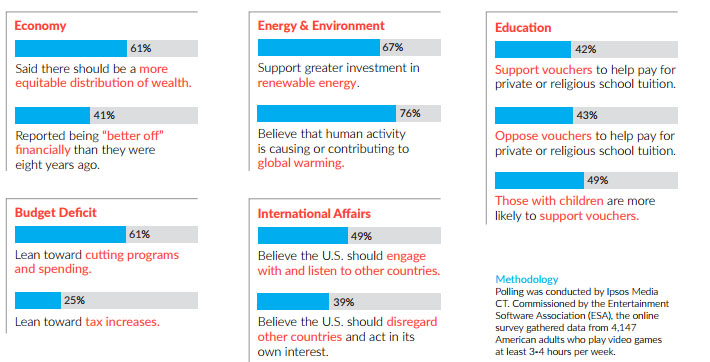
Oh Electronic Software Association, you’ve given me an early Christmas present. The ESA is the foremost data collector of statistics and data on video game consumption, usage, and attitudes.  Annually this blog reports on their essential facts about video game consumption, but today they’ve released a special report on their findings on how politically engaged gamers are. They’ve created a easy to read infographic of all of these statistics that I will be pulling from.

Now that were are officially a year away from the 2016 election, such statistics are as timely as ever. Spoiler alert: Most gamers  don’t think America’s leadership is a monarchy ruled by Princess Zelda.

votingThe results are overwhelmingly positive: gamers are very politically engaged. In a survey that asked whether or not they would vote in the 2016 election, 80% of gamers said they were going to exercise their right to vote. This is in comparison to non-gamers, which had a percentage of 75% respondents saying they were going to vote in next years election.

“100 million gamers will vote next year…Gamers are engaged, informed and hold strong opinions on critical issues. From both sides of the aisle, and in every state across the country, they will influence the course of our nation’s future.”

partyIn terms of political party, gamers are split even with an equal amount identifying as
Republican and Demographics. This doesn’t surprise me all that much, as it closely represents the general demographics on the United States, further showing that gamers are the general population. That said, significantly more gamers identify as conservative than liberal. Why gamers skew heavily social conservative is beyond me, and on what issues they lean conservative isn’t specified

Lastly the survey looked at what gamers think about specific issues.

issues

There’s some really interesting insights into how they fall on issues and this is really one of the first studies to actually ask these specific questions.  Despite the majority classifying themselves as “conservative” their political leanings on issues definitely have some socially liberal slants.

With the statistics out of the way, we can hypothesize as to why gamers tend to be more politically active than non-gamers (or at least say they are). It could certainly have something to do with their connection to online communities; video game communities are gathering places for people to discuss on-going issues. Places like NeoGaf’s off-topic forums ignite intellectual debates in their threads, and this creates public awareness for issues people may not typically come across in their daily lives. Whatever the reason for this political engagement, it’s a beautiful thing to see gamers getting politically active. There are issues out there that concern all gamers; A more politically engaged community is one that has a greater voice.

I think Simon Rosenberg, president and founder of NDN, says it best in the ESA press release:

What is so striking about this research is how deeply mainstreamed video games have become in our culture…The views of gamers are as diverse as the nation itself, and there can be little doubt now that playing video games is a near universal activity at the very core now of the national experience in the U.S.”

Not to brag or anything, but I’ve been saying that for years…Yeah, I’m cool.

Please head over the ESA website and support this type of research. We need more of this stuff, it really does make for a more educated and informed video game community.

Pew Research Center’s 2015 Findings on Console Ownership

Less progressive parts of the gaming community are in an uproar today, as a new survey suggest that more American women own video game consoles than their male counterparts. Should chauvinistic males flee the medium for fear of cooties? We’ll look into that finding and more!

next_gen_consoles

The Pew Research Group is a well respected, non-partisan ,and non-advocacy research group that gathers data on public issues, attitudes, and trends shaping America and the world. This week they released their findings on technology device ownership, ranging from tablets to video game consoles. It’s great data to comb through, but I’ll be focusing specifically on the findings of console ownership.

Let me start of my saying this: It’s ridiculous that there is a backlash to this survey. Read any article reporting this survey and you’ll be met with juvenile comments from people saying it’s poor research, a conspiracy of sorts, or a sign that video games are going to hell. Regardless of the validity of the data,  such comments and responses prove that there still exists a vocal minority that represent backwards and offensive views. If this survey is true, we as a community should be thrilled that this once male dominated medium is now a more inclusive one. A diverse video game community is a stronger community and  these negative views do not represent the entire video game community.

With that said, lets examine the finding:

The number that is grabbing the most headlines is the finding that 42% of women own video game consoles, while only 37% of men own a console.  This result is contrary to what most would assume, as the ESA report on video game consumption found that male gamers were still in the majority. However, it’s not as inconceivable as it once was; female gamers are on the rise and they make up nearly half of the gaming population.

With that said, there are certain consideration to think about when looking at this data, such as does this data include respondents who are parents and own video game consoles because their children? Likewise, does this include respondents who bought video game consoles because of their multimedia uses and not their video game uses, and would otherwise not consider themselves “gamers”?  Although we don’t have an answer for these questions and these aren’t suggestions for why the data is as it is, such questions allow us to better interpret and hypothesize about the data in front of us. To create a better picture of console ownership, additional probing questions would have to be asked.

Next the survey looks specifically at the breakdown of race in regards to console ownership. This data is actually quite interesting if only for the fact that it’s not something most research groups typically delve into when conducting research concerning video game demographics. That said, it’s not all that surprising; the percentage of people who play video games is relatively similar across each race.

Likewise, the data on educational attainment  and community type is relatively unremarkable. It is worth noting that the educational attainment data is mostly tied directly with financial ability to purchase video games.

As stated at the bottom of the survey, the sample size surveyed was 948 respondents. This is a pretty healthy sample size; more could be included, but it’s viable enough to work off of.  The Research Group goes into their complete methodology behind the survey for anyone with lingering doubts about the survey. Given that, should we take all of this data at face value? Not necessarily. As I mentioned, this data doesn’t give the complete picture. There may be reasons why certain stats are what they are, but the data does  gives us a better picture than we had before.

In all, this isn’t the most earth shattering survey response. Not all data is shocking or dramatic, a lot of time surveys just confirm what we mostly assume. However, it’s important for groups like the Pew Research Group to conduct these surveys because they give us the raw data that we need to formulate our arguments and theories. They’re out there doing the hard work for us. No body wants me calling 948 people asking about whether or not they have video games, I swear.

Extra Life: Playing Games To Save Lives

Just a quick one today. I wanted to bring notice to an awesome cause and annual event.

“Extra Life unites thousands of players around the world in a 24 hour gaming marathon to support Children’s Miracle Network Hospitals. Since its inception in 2008, Extra Life has raised more than $14 million for local CMN hospitals.”

Extra-Life is an event that brings together gamers from all over the world to play games in support of the Children’s Miracle Network  of Hospitals.  In collaboration with the ESA, the event  challenges gamers to raise funds through pledges to their gaming marathon.  Participants will attempt to game for a full 24 hours, all for the cause of raising funds for a much deserved cause. Interested gamers can create a fundraising goal for themselves or a team at the Extra Life Website. This years event will take place  next weekend on November 7th, 2015 (Though they’ll take donations for any day!).

Whether you want to participate yourself, watch some streams of participating gamers, donate to the cause, or simply find out more information, head on over to Extra-Life.org for more details.

Such an awesome event just goes to show the amazing good that the gaming community can do when we come together for a righteous cause.

Developers Adapting Educational Games to New U.S Standards

New U. S standards in education are changing the way developers create educational games. GET YOUR EDUCATIONAL STANDARDS CORRECT, MATHBLASTER.

Common Core, a set of K-12 educational standards in math and language arts, has been adopted by 45 states across the United States, leading to new standards and guidelines in teaching. These new standards are an issue of hot debate right now, as many states are receiving push back and negative feedback to these newly adopted standards. According to multiple sources, including Education World and The Hechinger Report, game developers are racing to develop games that meet the standards laid out in common core.

This isn’t surprising for anyone tracking the development and implementation of video games in the  classroom. Recent research estimates that the market growth of educational games will increase substantially in the coming years; the industry of educational game is   a big and profitable one. The goal for these companies is to see their games be implemented into the classroom, which isn’t a lofty goal considering that over 70% of classrooms were found to incorporate video games in someway.

New on IOS: “Putt-Putt Reforms Education”

The number is only likely to rise in the coming years as more and more schools implement new technology into their classrooms, possibly fundamentally changing how children retain and learn new information. This is really interesting stuff, as just in the last decade we’ve seen how video games can be used as positive tools for educational reinforcement. From personal experience, educational games were used as a positive reinforcement tool in certain classes I took in elementary school. They worked, as students eagerly wanted to get their work done to be able to have more time playing games like “Sticky Bear” and “The Electric Chalkboard”. That was nearly 20 years ago, so I can’t imagine how complex and useful the games are now and days.  If this is to become a norm in education, we’ll have to track and evaluate the potential changes it has on both education and socialization.

Was there an educational game that really made a difference for you or a family member? Let me know, I’m interested to know how games shaped different learning habits.

In China Proposed Credit Score System Will Drop Score For Video Game Purchases

Live in China? Thinking about buying the newest Metal Gear Solid game? I hear in this one Snake-NO BUYING VIDEO GAMES ALLOWED

Gamers in China might want to think twice before purchasing their next video game, as China’s new credit score system may dock citizens for activities the government deems worthless.  Reports  are coming out about the new system which may change the buying and social media tendencies of Chinese citizens.  Jay Stanley of the American Civil Liberties has a particularly good piece on why this system might be cause for concern.\\

I’ll try and summarize the story

This past summer a new credit score system was introduced in China by the IT Giants who run the majority of China’s social media networks. They introduced it along side an App named “Sesame Credit”, which enables users to view their credit scores.The system seemed harmless, as credit score systems are programs that exist in many industrialized nations and, as of right now, the Sesame Credit app and system is optional; Chinese citizens don’t have to download the app or have a credit score assigned to them. However the Chinese government this week announced that a credit score system will be mandatory by the year 2020. It’s not yet know if it will be Sesame Credit (though it most likely will be) or a new program. That’s all fine and good, but what is being reported to affect your credit score is the real cause for concern:

China’s new credit score system will punish people for buying video games, posting anything political on social media, and even for having friends that post political things.

Hey…What? Even handheld games?

Sorry Tomorrow Children, not even you will be accepted.

Obviously this issue is much bigger than just one that involves video games, and stems from a government that is imposing heinous lifestyle restrictions on its people..but still, what the hey? Historically China has had a restrictive history with video games, but things looked promising when they released their ban on console games earlier this year. Inevitably this condemnation of video games in the way of hurting one’s credit score will result in more piracy, which is already a considerable problem in China. How should we as the gaming community take such an act? It’s hard to say, as this strike against the hobby of video games is such a small problem in comparison to the bigger issue at hand. This new credit system looks to reinforce a strict class system, as credit scores will be used to determine one’s “opportunities in life”: if one is fit to serve in local politics, be hired for certain jobs, etc. What worse, is the system is reportedly going to dock users scores for things friends say on social media, meaning that the system will create a pseudo social pressure to not saying anything controversial for fear of it ruining, not only your own credit score, but your friends’ as well.  Such a system will be detrimental to those seeking a change in politics and ideology in China.

We’ll have to keep an eye on this story as it progresses, as it could be pretty harmful to the burgeoning video game community in China.

Games For Change Student Challenge

Games For Change, an awesome organization that promotes and develops games that have a social impact on the world, has launched a challenge to New York City students: Make a game about a real world issue in your local community.

Games for Change partnered with the New York City Department of Education to work with NYC teachers to teach them how to teach game design to their students. Sometimes you gotta teach the teachers to teach so that they can teach.  Participating Teachers and schools will work with students to create original games about social issues facing them and their community by creating game design courses in their schools. However, the program isn’t just for kids from schools that run these programs, any student from NYC can submit a game to the program.

Students have the option of 1 of 4 themes, each depicting an ongoing issue in the NYC community. The themes are structured, so you probably won’t see any games about the social woe of Pizza rat.  Students will then create a digital game with one of these themes in mind, and submit their game by the end of January 2016. Six winning games will be named and the creators will receive prizes and awards.  

games for change

The Games for Change Challenge seems like a really innovative way to spark an interest in social issues and game design in the NYC students. While only centralized to NYC, it’s great to see such a program taken underway. Hopefully such a project will spark other projects from G4C, or other similar organizations. With this and the Street Arcade, we’re seeing kids take to games to convey social issues more and more.

“The Street Arcade” – Teens Create Games to Combat Social Issues

A quick one today for anyone interested in seeing some socially infused games in the Chicago area. Steve Ciampaglia, an assistant professor at Northern Illinois University spent the summer with his partner, Kerry Richardson, working with a group of 13 teens to create video games that feature social issues. They’re inviting the public to come and join them in showing off their hard work at “Street Arcade” on September 2nd in Chicago.

From Ciampaglia’s description, the games all tackle a social issue for which the teens wanted to discuss. These themes range from the representation of minorities in the media to the challenges of immigration. To see video games that tackle social issues is in itself really awesome, but that fact that it’s teens making these games make them all the more worthy of note and discussion. More and more we’re seeing that video games can be powerful tools of social change, so it’s heartening to see that such a event and project exist.

You can find out all about the games and the event  at NIU’s news piece  right here!

Report on the Status of Teens’ Use of Technology in Social Life

The PEW Research Group has recently released their 2nd  of 3 reports on “Teens, Technology &  Friendships”. PEW, which describes themselves as  “a nonpartisan fact tank that informs the public about the issues, attitudes and trends shaping America and the world”,  has conducted extensive research to academically confirm something we all probably know: Teenagers are using technology  to maintain social relationships.

thispos

If you’re mind has just been blown, please take sometime to compose yourself and in the near future you might want to reconnect with society (Google has self-driving cars now, don’t be scared). The report itself is actually pretty insightful and explores how teenagers use video games in their social life more thoroughly than any study I have seen previously. It’s obviously isn’t going to be ground breaking conclusions, but a big part of sociology is academically documenting and observing trends in society.

There’s a lot of information we could go over, most of which dealing with how teens are using social media sites and apps like Twitter, Instagram, and Facebook to create and maintain social ties, but for the sake of only going over what most pertinently concerns this blog we’ll only be delving into the report as it concerns video games. LET’S JUMP IN:

“52% of all teens spend time with friends playing video games; 13% play with friends daily.”

In line with what the ESA reported on video game usage for 2015, this statistic doesn’t surprise me. Gamers in general are becoming more and more social, so it’s only natural that you’d see teenagers take advantage of this as well. Games like World of Warcraft and Halo are cited as specific games that have been used as tools for socialization within teen social groups.

“Overall, 72% of teens ages 13 to 17 play video games on a computer, game console or portable device. Fully 84% of boys play video games, significantly higher than the 59% of girls who play games. Playing video games is not necessarily a solitary activity; teens frequently play video games with others. Teen gamers play games with others in person (83%) and online (75%), and they play games with friends they know in person (89%) and friends they know only online (54%). They also play online with others who are not friends (52%).

This is a little confusing to read because of all the numbers. The way to read these numbers is the percentage of respondents that fell into that group. Don’t try and add them up, as individuals may fall into multiple categories (for example, a teen may respond  that he plays online regularly with friends he met online AND plays with people who are not friends).

What’s interesting here is to examine just how much video games have pervaded our culture. On whole 42%* of Americans play video games regularly, so for 72% of teenagers to play video games  regularly one can hypothesize that the number of Americans who play games regularly will probably continue to go up year to year. Likewise, just the sheer number of teens playing online is remarkable. 10 years ago that amount probably would have been halved. It’s not all that surprising, what with all major consoles being online  and the majority of AAA games having some sort of online mode, but it’s dazzling to see for someone who grew up in an era in which video games were mostly a solitary activity.

  • -38% of all teen boys share their gaming handle as one of the first three pieces of information exchanged when they meet someone they would like to be friends with; just 7% of girls share a gaming handle when meeting new friends.

  • -Of teens who have met a friend online, 57% of boys have made a friend playing video games. That amounts to 34% of all teenage boys ages 13 to 17.

These two are particularly interesting, just because these aren’t the type of statistics most studies will look into.  It makes sense that a good portion of teens making friends online would do so in a video games, as it’s a common ground for people to meet and share something they’re both interested in.  If anything, I’m more interested what the relationships of people meeting in others  online grounds would be; forums potentially have the same effect, but social media sites are more of an oddity in my mind. Regardless, it shows that technology is being used in various ways to strengthen and even create relationships.

When playing games with others online, many teen gamers (especially boys) connect with their fellow players via voice connections in order to engage in collaboration, conversation and trash-talking. Among boys who play games with others online, fully 71% use voice connections to engage with other players (this compares with just 28% of girls who play in networked environments).

This one is the statistic I found to be the most interesting, as one might be able surmise a bigger problem at work.  With 59% of girls playing video games, it’s surprising that only 28% responded that they play with voice communications. In a interview by Kotaku, a lead author of the report concluded that this means only about 9% of girls playing video games are using voice communication in online games. Why the low number? The study unfortunately does not go into why this may be, but if I had to guess I would say they may be a mix of practical and troubling reasons for the community. I don’t want to make assumptions, but it wouldn’t surprise me if one of the reasons found were because teens girls had negative experiences when playing online with others. I’ll leave it there.

This chart is exemplifies this gender difference between how male and females are using video game communities. For boys, video games are being used as social outlets in the same way text messaging and social media is being used, which is something one might not automatically assume.

There’s much more in depth analysis in the report itself, which can be found here in its entirety. The grand take way to the entire report is that technology isn’t causing the social relationships of teens to diminish. Yes, teens aren’t connecting the same way they did 20 years ago, but they’re still connecting and the social bonds they create aren’t any less real or solid. Technology, in many ways, is augmenting the ways we connect with others and even allowing us to reach groups and people that we wouldn’t otherwise be able to connect with.  So, the next time you see a teen on their phone don’t scoff or dream of the “good ol’ days”, just realize that society advances and restructures how we socialize.

*Data from ESA 2015 Report

Follow us on Twitter!

Review: “Double Fine Adventure!”

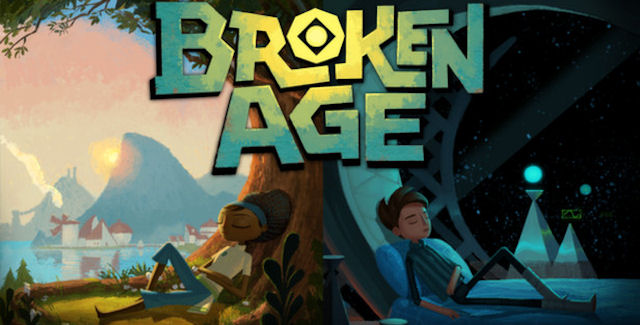
Not all documentaries are created equal, especially when it comes to ones focusing on the world of gaming. It’s rare that a video game documentary is something I can recommend, as many don’t do the subject matter justice (See my review of “Video Games the Movie”). However, occasionally we’re graced with some really excellent film making the tackles the subject in an interesting and well thought out way.  2 Player Production’s Double Fine Adventure is that rare film.  I say film, but it’s actually closer to a show as the piece was originally broken up into 20 episodes that were released as the game’s production went on. As a whole, DFA chronicles the development of the Double Fine point and click adventure game “The Broken Age”. From the game’s initial Kickstarter all the way until the game ships, you see the whole process on film.

broken-age-walkthrough

What sets DFA apart from other films/series of its type is just how true it is to the development process of a video game. It’s not all glitz and glamour kids, making a video game is a difficult process that has emotional highs and lows. Movies like “Indie Game The Movie” focused on this as well, but DFA has the unique perspective of showing the ins and outs of an established video game company that works and lives game to game. Despite being a fairly known development company, Double Fine isn’t Naughty Dog, Nintendo, or Capcom; they’re a considerably small company that has a lot of the same struggles that independent developers face.

To give a little background on the subject matter, Double Fine Productions was founded in 2000 by ex-Lucasarts developer Tim Schafer, who created many of the company’s amazing point and click adventure titles such as Grim Fandango and Full Throttle.  Based in San Francisco the company has developed several cult hits including Psychonauts, Brutal Legend, and Costume Quest, but had not returned to the point and click genre until the announcement of the Kickstarter campaign. The first episode chronicles the initial Kickstarter that funded the game, which raised over 3 million dollars over the course of one month.

From there, the piece shows viewers how a game goes from inception to completion from stage to stage. This is where the piece becomes essential for anyone interested in video game design or the academia of gaming. Each episodes chronicles a stage of the video game process, for example there’s an entire episode where the team brings in art consultants to draw out facets of the worlds to motivate and help Tim visualize the world he’s trying to create. Slowly but surely you can see the game take form, which is even more interesting if you have already played through “The Broken Age”.  Along the way the documentary introduces you to key members of the Double Fine team, whom the viewer really gets to know and empathize with through the course of the years that the documentary was made. When the team fails to miss a deadline the viewer feels the emotional weight that the team themselves are feeling, as over the course of the episodes you become more and more invested in this game being developed.  Likewise, when Tim first previews the game to a crowd of fans you feel the emotional high that Tim and his team felt in that moment; start to finish, the team at 2 Player Productions do an amazing job of documenting the humanside of game development.

This type of documentary may not have worked with all developers, but Double Fine is home to such a devoted and creative group of individuals that you create a relationship with them over time. The main man himself, Tim Schafer, really exemplifies this more so than anyone else; you get a very good sense of just how much he truly loves gaming (especially the point and click adventure genre) and the fans that have placed so much support in him and his staff.  It’s an underdog story through an through, as the film shows how a small development company can make a successful in a genre that was deemed financially dead by the gaming industry. As I mentioned in my pieces on Kickstarter and Crowdsourcing websites, games like the Broken Age show that the conventional methods of getting a game developed are no longer the only options: We all now have a say in what games we want to see developed and made.

To Summarize: “Double Fine Adventure” is a must see for anyone interested in the gaming industry. It may very well be the most true to life look of what it’s like to develop a game in this current gaming climate. Shot beautifully and with care, the film will change your perception of what goes into the games we play. Go check it out, and while you’re at it play the Broken Age. It’s also a terrific game.

You can pay to see the whole film here, or you can watch all of the episodes without bonus features on Double Fine’s Youtube channel.

Follow us on Twitter!