

Published recently in Addiction and Research Theory, a paper entitled “Social responsibility in online videogaming: What should the videogame industry do?” questions whether developers of online video games should actively do more to prevent players of their games from getting addicted. Should they? Will they?

Before we delve into the content of the paper, we should make note that video game addiction has become a growing problem over the years, grabbing many headlines and creating quite the concern. For some statistics about video game addiction, I’d advise to head over to www.techaddiction.ca for some interesting facts about this problem.
ONTO THE PAPER I SAY!
The paper has already gained notice in the press, as both the BBC and Washington Post have written articles about it:
Do video game makers owe it to players to keep them from getting addicted?
Do Online Game Developers Need to Do More to Prevent Addiction
The paper, given what we know about addiction to video games, calls for developers to decrease some of the elements in their games that cause addictive tendencies. This includes decreasing the number of long missions, decreasing the importance of doing repetitive tasks for the sake of leveling up characters (Grinding or farming), and making crazy uber-rewards for players who sink countless hours into the game. While many gamers may find these aspect of their favorite games essential, they’re often the most time consuming and addicting parts of them. Should game developers comply? Is it reasonable to be asking them to take measures to prevent addiction when video game addiction, for all intensive purposes, is financially positive?
While some of what the paper calls for seems a little far fetched, specifically taking out grinding, some publishers have already taken steps to prevent their games from getting overly addicted. For example, Blizzard Entertainment, the maker of World of WarCraft and most of the games that will get you addicted, took out a reward in WOW for players who reached the highest level possible to prevent gamers from over doing it for the sake of obtaining this reward.  Likewise, warning of over-playing have been used in numerous games in the past. Nintendo, for example, ask players to take a break from playing in several of their games if they exceed a certain number of hours in game. Similarly, games like Animal Crossing even go as far as to only allow players to do certain content during normal hours of the day, not giving players much to do during night hours. These little reminders, while easily ignored, do help to remind gamers that they need to step away from their gaming devices every once and awhile.
With gaming getting more and more intertwined with daily life, it’s only natural that more and more gaming will become addictive. You can talk with your friends, watch shows with them and even share content, so the need to remove yourself from your gaming devices is lessening. So perhaps it is up to gaming developers to at least try and make some in-game attempt to prevent their players from over addiction. It’s not crazy, honestly; we ask our manufacturers of Alcohol to ask their consumers to not over do it. Social responsibility for their products is not asking too much of game developers. After all, a healthy gaming populace is a happy gaming populace.
If you have an opinion, please let me know! I’m very interested to learn what players of MMOs and other games that fall into what the media calls “addictive” think about this matter. Not being a MMO player, or much of an online gamer, myself I can really only take the stance of an outsider on this.


 One feature lacking is the ability to change or choose your characters skin tone. Gamers of colored have asked “Why can’t my character’s skin color match my own”?
 As I mentioned, Doc Lewis and several of the punch-out casts were characters of color, so it was certainly possible. Even McKids featured a non-white playable character. Is Nintendo really unable to do what McKids can? Regardless, Nintendo has had 20+ more years to make more characaters, and with expanding universes like the Zelda universe there’s no reason why Nintendo can’t create more diverse characters.
 Kirby can obtain abilities anywhere from wielding a sword to turning himself into a laser; if you can steal it, you can do it. Some may say he’s a down right dirty stealer, who murders his victims and steals their best abilities. All of that is true. Kirby is a terrible monster, but it’s pretty fun to be a monster. One could theoretically go through out an entire game and only use Kirby’s basic abilities, but wheres the fun in that? Kirby teaches us that to get through life you have to take on many different roles and aspects; ya gotta be multifaceted. That’s a great lesson to learn. Learning how to go with the flow and take on roles as they come to you will serve our youth well.
 The original Kirby’s Dreamland tells the tale of our hero, Kirby, going after the tyrant King Dedede. Dedede has stolen all of dreamland’s food and is keeping it all for himself, so it’s up to Kirby to redistribute the goods to the people of Dreamland. Of course, through Kirby’s political maneuvering King Dedede eventually reaches across the aisle and sees the errors of his way, but whats this classic tale of a greedy king telling us? It’s social resistance, of course! Kirby doesn’t stand by and just watch the powers that be take and take, he takes action and rebels! That’s a good lesson to learn, but hopefully it won’t lead our youth to distrust royal birds. The emperor penguin would be screwed.
 Over the years, Nintendo of America has made some odd alterations to the official box arts design they receive from Japan, most notably is that they have switched an otherwise happy Kirby to an angry Kirby on several of the franchises box arts. Why? Who knows. Maybe NOA thinks Americans like their characters pissed. Or maybe there’s something about heading outside of Japan that just makes Kirby naturally angry. It could be that the boxarts just do it themselves; Kirby perhaps hates America! If there’s one thing that we can take away from all this is that America is a much more serious place than the whimsical land of Japan, where pink balls have the delight of going on adventures without anger or frustration. What a terrible land we live in that does this to creatures whom only want to suck and feast on the bounty of abilities in their way.
 but games that are exceedingly difficult have become far more popular this console generation with games like Dark Souls and Demon Souls promoting being the hardest of the hard. Are we masochists for playing these games? What about difficult games appeal to us? Shouldn’t we want to stay away from games that are difficult and make us fail more? Logically, yes. We logically should want to stay away from things that make us fail….And yet we don’t with video games. Why?
 You could even try and go get help for this issue, but the looks and stares of the medical professional just makes you sick to your stomach. Eventually they’re moving out all of your stuff out of your room, seeking to find that hidden Mario Kart cartridge you have hidden away in the loose woodplank beneath your bed. “YOU’LL NEVER FIND IT!” you scream from your full body constraint, only to receive another injection of tranquilizer to calm you down. Muttering ” “DK Jr. Just likes the bananas” as you fade out of consciousness, you might even wonder if it’s all just one big trick devised by that dimwitted Donkey Kong……
 every day, hundreds of millions of people around the world play video games, and most of them will experience failure while playing. It is safe to say that humans have a fundamental desire to succeed and feel competent, but game players have chosen to engage in an activity in which they are almost certain to fail and feel incompetent, at least some of the time. In fact, we know that players prefer games in which they fail. This is the paradox of failure in games.

 Media Molecule Studio Director: “It takes women working on games for games to change”
 She believes by empowering females to design and make games that the gaming industry will change for the better. We’ve certainly seen the call for this in other avenues, such as



 About a year ago I used some of my built up coins to get their 3-set of 25th anniversary posters for the Legend of Zelda, and they’ve made amazing additions to my apartment. In fact, I even framed one of them.
 Economist and psychologist probably can express it better, but essentially SET says that society is a series of social interactions in which people determine their outcome by rewards gained vs. negatives lost. Basically laid out, the thought process behind most interactions can be shown by this equation.

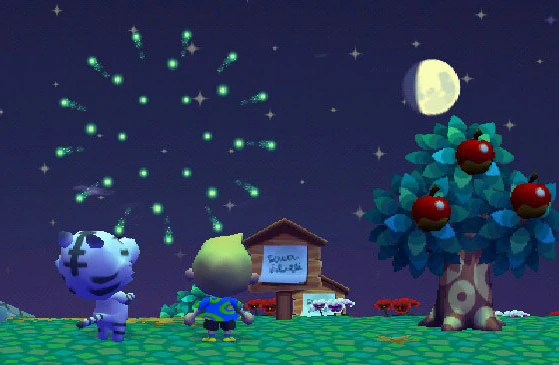 Because the series works off an internal clock and calendar, it knows when holidays and special events take place. Typically, depending on the holiday, the characters in-game will do something special like give you gifts or have a special event like a fire-works show. Of course, since the game a global game it doesn’t exactly call independence day by its name, but instead “Fireworks show day”. You’ll see no flag wave or BBQ have from these animals. Note: the latest installment, New Leaf, will not hold a fireworks show on July 4th. Instead, the game will have Fire-Works day later in the summer. Sucks, I know.
 Released on the PC in 1994 as a follow-up to Civilization (Also remade apparently) the game lets you take the role of either the British or American settlers up to gaining Independence. The game makes you work for it however, as you’ll have to deal with trading routes and native populations (There’s nothing quite like celebrating America by decimating Native populations), as well as getting your settlement off the ground correctly.
 Developed by From Software, developer of such games as Demon Souls and Armored Core, this hyper patriotic game never made its way to the United States. I’m not going to lie, I’ve never played it, but it sounds to be the most absolutely ridiculous and awesome game in one. Sedt in the near future, you take the role of the President of the United State that has been the attack of attempts to usurp his position. After narrowly escaping the White House in his mech suit (Yeah, that’s what I said) he attempts to regain control of the country from an administration that reigns terror and even slavery. We could analyze this game all day, but it’s essentially Mechs, patriotism and explosions the game. While it doesn’t directly celebrate Independence Day, it will give you such a patriotic overload that you’ll feel like waving a flag and gouging out your eyes.
 Why you may ask? Because Aliens hate freedom…Well at least the ones in the movie did. With each alien ship you shoot down a tear of pure American freedom will fall down your cheek. But really, it’s actually not a great game. But if you’re really hankering for some pseudo- Will Smith, 4th of July having action, then maybe give it a shot.
 The Sociology of Videogames