Here is a link to a great piece by Luke Karmali of IGN about the lack of gay characters in video games. While he does note that representation and inclusion are up considerably in the last few years (mostly in part due to western studios such as Bioware and Naughty Dog), it is still an uphill battle to get proper and adequate representation for the LGBT community in gaming.
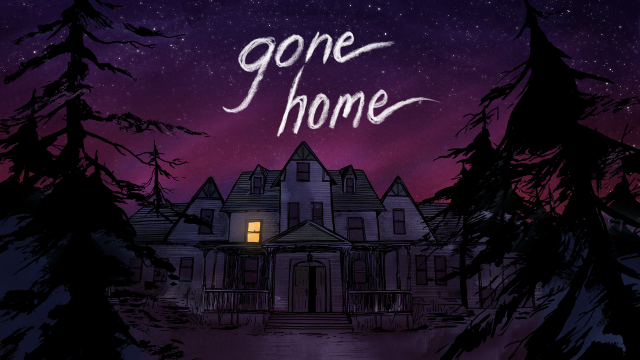
“Gone Home” is one the few games to feature a LGBT relationship.
Growing up is hard. Growing up in a world where you find it nigh on impossible to catch sight of someone you can relate to is harder. The inclusion of gay characters in games leads some to believe that one day there will be no heterosexual characters they can choose to play as, that this is a slippery slope that will inevitably cause entire entries in popular franchises to be populated exclusively by LGBT characters. Such a premise is ludicrous. It’s also the exact reverse of what’s facing young lesbian, gay, bisexual and especially transgender gamers – who are represented even more poorly still – in most titles today.
I won’t say much more about the article, as the author has already said everything much more elegantly than I could ever, so please take some time and give the article a read. For more articles about the LGBT Community and Gaming, check out these articles:
Will Mario and Pals be your new drinking buddies? For years video games have been in bars; an old arcade cabinet here and there, or even bar specific games that typically have to do with gambling. However, it seems video games are steadily making their way into bars more and more in new ways.
Today, ReCode.net has a review for Folsom Street Foundry, a bar/event space located in the San Francisco SOMA area where weekly video game nights are occurring on Tuesdays. These game nights, which have been going on for weeks now, have ranged from Bubble Bobble Duels, live watching of Twitch Plays Pokemon, and Smash Brothers Tournaments. Although conducted by an outside event group, the weekly game nights are growing in popularity and proving that video games and drinking is a combination for success. At this point you may be knocking your head against a wall crying “WHY DIDN’T I THINK TO OPEN A VIDEO GAME THEMED BAR!?”, but don’t fret: there’s room to grow. Of course Folsom Street Foundry isn’t the first bar to incorporate video games and drinking, but it does seem to be one of the latest and greatest.
The combination seems obvious, pop culture and the bar scene, but video game themed bars have been slow to start up. This could be in large part due to the start-up costs for bars and the additional cost it would take to have hardware to run multiple video games. Likewise, as anyone who has ever had a college party at their house may know: electronics and drinking is a recipe for disaster. That said, with the success of Folsom Street Foundry and Barcade in Brooklyn there definitely seems to be a niche for video game themed bars.
So why does this blog care? This isn’t only a testament to my own personal alcoholism and addiction to video games, there’s some decent social implications for this rising trend. As video games become more and more accepted into our culture they begin entering scenes and parts of culture they’ve yet to touch before. With video games entering bars and social scene they too become greater intertwined in our social sphere. That’s right kids, video games are now in your social world. Your next date may take you to a video game themed bar in which you and your date bond over a game over Crash Team Racing.
“So where did you grow u- OH DAMN YOUR EXPLODING CRATE, YOU ****”
Have a favorite video game bar or video game themed drinking idea? Let the people know by dropping a line in the comment section!
And now, for the sake a fun (since there’s no sociologically relevant reason I can think to do this), here are some video game themed drinks and ideas to liven up your video game themed bar or party. These are the ones I found to be pretty cool, though you should definitely check out the website for more ideas.
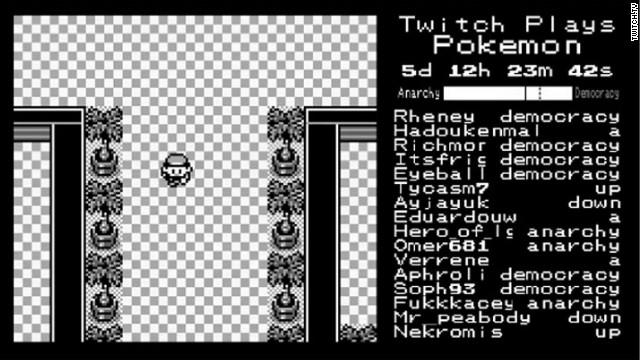
The past few days a social experiment has taken over Twitch. Twitch, for those who may not know, is an interactive streaming website primarily focused on gaming. This past week, a user by the name of TwitchPlaysPokemon uploaded the 1996 classic Pokemon Red to the servers of Twitch, enabling the game to be controlled via chat commands. The results are hilarious, interesting, and insane.
When the game went up on Twitch earlier in the week the play mechanics were amusing and novel. A player, in a chatroom of about 100, could enter a command and see the onscreen player move accordingly. Then thousands and thousands of people jump aboard. At its peak, Twitch is reporting that over 80,000 players were participating and watching at once. The result is a spastic main character who seems to be struggle to do anything but walk around in circles. The goal, now, has become to journey through the game as a group.
However, to better function tweaks have been made to the game. A few days ago, a change was made to the game to allow for a more civil play experience. Players now have the option of voting for either Anarchy or Democracy. When the majority of players vote for Anarchy, the game is carried out in the same fashion as it was when it first began; chat commands from all players dictate how the main character moves. When the majority of players vote for democracy, chat commands are disabled and players instead vote on what movement to make and the game moves with the majority move. Of course, it even gets more absurd when the game gets thrust into battle. The results have been absurd and have spawned memes and jokes across the internet.
I don’t have time to explain the Helix thing..
The sheer fact that this democratic system for working together has arisen in this chaotic world is incredibly interesting, both from a gamer’s perspective and a sociologist perspective. TwitchPlaysPokemon has become a fascinating case scenario for how the internet can create unique social experiences in places that once were not social. It shows the creative ability of group interaction to change and add new life into something from the past, and re-imagine what it is to play video games together.
Even if you’re not into for its social implications, it’s still a hell of a funny thing to watch.
A few months ago during E3 I asked the question whether Nintendo was being more gender inclusive after the inclusion of lead female characters in most of their E3 line-up. Yesterday, the Nintendo’s Girl Club youtube channel popped up on youtube, giving further evidence that Nintendo is really stepping up their efforts to appeal to a wider audience.
The introductory video (posted above) promises trailers and news presented by the channel’s host Jorgie Porter and other female fans of Nintendo games and franchises. All in all, it seems like the channel will be just that: female gamers talking about games and news relating to Nintendo. It’s a welcomed and novel approach, and it does show that Nintendo is at least trying to appeal to female gamers. I doubt we’ll see any hard hitting insight on the channel, but it’s good nonetheless. This comes after many divisions of Nintendo have launched a marketing campaign to appeal to a wider demographic of gamers, including commercials and games that more widely appeal to a greater audience.
If you are or know a young girl that is a fan of Nintendo then they may enjoy this new channel. I realize this entire post reads like a advertisement for Nintendo, but I thought it was something worth noticing.
Today in The Biology of Video Game news (Wait, that’s not what this blog is…)
Jokes aside, a recent study suggests that there may be benefits of video games on those with dyslexia. This is important news to those with children struggling with dyslexia or those themselves who struggle with it, which is about 5%-10% of the population. I won’t go into the study all too much, but essentially the study found that children with dyslexia were able to match those without dyslexia when it came to reacting to a visual cue followed by a sound cue, as opposed to being asked to reacting to cues broadly.
Hey, what does that have to do with video games you may be asking. First of all, I don’t know why you’re asking a computer screen, and secondly, this finding would suggest that video games may be able to assist with dyslexia because video games may be able to get children with dyslexia more accustomed to switching between audio and visual cues. As one of the researchers behind the study suggest:
“The idea is to train with some kind of video game that trains the eye movements to different locations to add in that multisensory component,
Maybe in the future we’ll see games developed specifically for kids with dyslexia to help alleviate the problem. It certainly wouldn’t be far fetched, as we already have plenty of video games meant to teach kids basic reading and writing.
I don’t know what this game is, but it looks like so many of my nightmares.
So at this point you may be asking (as we’ve already established you’re a curious one) what does this all have to do with sociology. Well, if video games can help alleviate dyslexia or train your brain in other ways, then certainly they will become a more important part of our social world. The more evidence of the benefits of video games, the more they become a social norm in our society. That’s not too bad for us gamers, right?
Check out more classic video games re-imagined as children’s stories Here!
New York Time is reporting an increase in the number of companies using video games to screen potential employees for their creativity, problem solving ability, multitasking ability, and more. Does this mean playing Double Dragon will be an key part of your next job interview?
One such game being used to screen potential candidates is Wasabi Waiter (Pictured above), a game that makes candidates figure out which sushi dishes to serve to which customers. While this sounds like a strange scheme that a 1st grader would concoct, some big name companies have been utilizing games like Wasabi Waiter to make the hiring process more efficient, cost-saving, and unique. However, the Times’ piece raises question as to how effective and fair these methods of screening candidates are. As the author mentions, they run the risk of unfairly screening out entire classes of workers in favor of those with more affluent higher education and means. Likewise, it’s unknown how effective these games are measuring employees’ capabilities and the level of match for a certain company. As the author to the Times’ piece mentions, in this job climate many jobs’ responsibilities and skills can change over the course of one’s employment, meaning that these games may only be able to test for the skills required at hire, if those.
Before you claim vindication over your parents saying video games were a waste of time, we have to ask: should you expect to play a gimmicky video game on your next job interview? Probably not. Very few companies have adapted this means of screening candidates, and most seem to be within the sphere of the video game industry. The greater question is whether this means of screening candidates is a valuable one, and that remains to be seen. For better or worse, video games are becoming more and more apart of our social world in ways we probably didn’t foresee, and sooner or later sociologist may have to examine how their influence are effecting our daily lives.
A highschool in Norway is using Telltale’s acclaimed “The Walking Dead” series to teach their students about ethics. Will these kids learn actual ethical insight, or will they only learn that Zombies = bad news?
The school was brought to attention by NRK, a media outlet in Norway that reported on the class. A video of the report can be seen here (Warning, it’s in Norweigin, but you can hit the translate button if you don’t speak the language).
According to the report, the game is being used to give student ethical dilemmas that they may not otherwise be given. Before you assume these ethical decisions are “Be a zombie murder or not?”, bear in mind that the series has been acclaimed for making players actually feel for their characters and feel the weight of their decisions. Unfortunately I personally have not had a chance to play the series, but I’ve heard they’re very well respected and well developed in character design and progression.
The report also claims that students have had positive results using the game to teach students ethics, as the game has spawned lively discussion of many of the ethical dilemmas that are presented in the game. Likewise, the students are reported to be much more engaged in this form of teaching than in traditional forms of teaching ethics.
Such a report begs the question: should video games be incorporated into more classrooms? Certainly there has been evidence to suggest that video games help engage students in school, but are they more successful in teaching than traditional means? That remains to be seen, and anecdotal evidence like this can only be applied to the situation. Certainly The Walking Dead wouldn’t be appropriate outside ethics and philosophy classes, but perhaps other games can help bridge the gap between education and video games. Similarly, one must ask: are using video games in the classroom any different than using television or movies?
A Recent study out of Nottingham Trent University, and reported on by Gamespot, claims that playing video games for may cause hallucinations. Should we be worried, or should we just forget about it and continue to try and get Donkey Kong out of my backyard?
The study is based on experience compiled by gamers collected on online gaming forums. The fact that the study is relying on personal experience from internet testimonial is already questionable, but we’ll just go ahead and move on. Gamers reported seeing distorted versions of reality that included aspects of games after playing for extended periods of times. This could include things like seeing gaming menus, signs, or even options in the real world. This phenomenon the research team calls “Game Transfer Phenomena”is what they describe as “how playing games can affect a person’s sense of sight, sound, and touch after they are done playing”. These experiences were mixed, with some gamers having uncomfortable experiences in which they were unable to concentrate, confused, or even worried about the perceived objects they saw.
From personal experience: One night, after a particularly long session of playing the 2001 title “Super Monkey Ball” the game seeped into my reality. Day was night, light was dark, balls were filled with monkeys. Had my loved ones been trapped in spherical cages, or was it all in my mind? As I navigated the mazes of my mind, and the ones manifested into my reality I began to laugh at the comedy of it all; for aren’t we all monkeys in our own balls? Trapped in our own spheres of lies and desperation? What a world to live we in; It’s Bananas.
…Where was I? Back to the article: Should we stop playing video games excessively for fear that Mario will sneak into our reality? Who knows. The research study team admits that relying on personal experience from an internet pool of respondents means that we can’t say that the group represents a majority of gamers. Further research needs to be done to see what type of gamers are more likely to have GTP occur and to see how and when GTP manifest, if it does. Regardless, it doesn’t seem like GTP is anything gamers should fear, as the majority of gamers didn’t seem to respond to having it. However, if true, GTP does mean that video games and media effect our brains in ways we haven’t quite figured out. Then again, is it just video games and other media that have this effect? One could argue that doing any activity for an extended amount of time can have adverse effects on one’s mental state and lead to sensations of that activity in normal life. We’ll have to keep an eye on the phenomena to further see how video games and media are effecting our social world.
If this sensation has ever happened to you (And not like the ridiculous lie I told) please share!
We’re back in 2014, with an article that looks into a study conducted by a research team coming out of Singapore. This specific study looks into why we cheat in video games.
I won’t go into the specifics of the study, as the wired article does that quite well, but it is worth discussing the findings of the study. The article reevaluates the belief that it’s anonymity that makes gamers cheat in online communities, and instead finds that gamer’s responded that they more often resorted to cheating because they believed others were cheating as well. Not only that, but they also responded that if one doesn’t cheat in online communities then they are at a disadvantage. Essentially, we’re all cheating because we assume everyone is cheating, and if you’re honest you’re probably losing. What an online world we live in.
Take some time and check out the article, and the study if you have the ability to. It’s worth a view.
I know this post is a bit on the sparse side, but I promise: more content and new articles in the future! Until then, happy new years and good gaming.
In recent years the indie video game industry has been revolutionized by the popularization of crowdfunding sites like Kickstarter. Since their popularization, numerous video games have been fully funded through the contribution of fans and gamers. However it hasn’t just been indie developers who have utilized kickstarter and crowdfunding sites, big names in the industry have begun to use these methods to fund their current or future projects. Major examples include Keiji Inafune’s MegaMan-esque F You to Capcom “The Mighty No. 9” and Tim Schafer and Double Fine’s awesome looking “Broken Age“.
Surplus Crowdfunding Paid for Jack Black and Elijah Wood!
With such names as Inafune and Schafer jumping on the crowdfunding train to fund their highly anticipated games that otherwise might not see funding, it makes one wonder why other developers haven’t used the method to fund niche or cult classic sequels.
It could be because the results of bigger developers using crowdfunding to fund their projects have yet to show conclusive evidence that the games A) turn out well and B) serve profitable to the company. This is in part due to the fact that Doublefine is amongst the first big development studios to use Kickstarter to fund their project, and Broken Age’s success has yet to be seen.
Keiji Inafune’s Mighty No. 9 isn’t MegaMan. He swears!
However, there are numerous big name games out there that would be perfect for the crowdfunding route that it’s a wonder why they haven’t already been put up on Kickstarter already. I’m not suggesting big studios like Microsoft or Activision use Kickstarter to fund the next Call of Duty game, but studios using crowdfunding to develop cult classic requested games that would otherwise not see funding is seemingly the perfect route. One specific example that comes to mind is Shenmue 3.
When the original Shenmue was released for the Sega Dreamcast it was the most expensive game ever to be developed. The game had a remarkable $70 million development budget, meaning that to turn a profit for Sega every Dreamcast owner had to have bought the game twice. Needless to say, the game had disappointing sales due to Dreamcast’s own poor sales despite being rated one of the Dreamcast’s best games and one of the consoles 4 best selling games. The game secured a sequel, if only because both games were developed side by side, but creator Yu Suzuki had planned the game’s story to go on for several titles. The development of the series ended with 2, only to leave fans with questions and an unresolved storyline. For over a decade (Yes..it’s been that long) fans have been calling for a third title only to have to continue to wait. Shenmue is amongst the greatest examples of a title that would be perfect for crowdfunding, as the support and fandom is there. Creator Yu Suzuki has acknowledged that Kickstarter would be perfect for the title, but nothing has been announced as of yet. This could be due to Sega not wanting to relinquish the rights, the enormous amount that it would cost to make an acceptable sequel, or any number of reasons. However, there is still hope for Shenmue fans; at this 2014’s Game Developer’s Conference Yu Suzuki is holding a Postmortem discussion on the franchise with Mark Cerny, Game designer and lead architect behind the PS4, translating and leading the discussion for fans. While fans shouldn’t get their hopes up for an announcement of 3, it is great to know that the franchise is still on the mind on developers and its creator.
Who knows if we’ll see bigger developers turn to Kickstarter to fund their games, and many may argue that they perhaps they shouldn’t. Regardless, Crowdfunding is a important shift in the video game industry, one that proves particularly interesting for those interested in the social aspect behind video games. This shift towards crowdfunding means that video games no longer have to be only a consumer good. With fans getting involved and even funding the backing for these games they become a much greater part in the development of their favorite titles. Funded by the people, for the people…..That sounds lame.
What titles or developers would you like to see have the crowdfunding treatment? If you have an opinion please feel free to drop a line in the comment section.
Check out the GDC page for the Postmortem Disussion









 Day was night, light was dark, balls were filled with monkeys. Had my loved ones been trapped in spherical cages, or was it all in my mind? As I navigated the mazes of my mind, and the ones manifested into my reality I began to laugh at the comedy of it all; for aren’t we all monkeys in our own balls? Trapped in our own spheres of lies and desperation? What a world to live we in; It’s Bananas.


 The Sociology of Videogames