How Riot Games Cut Down Online Harassment in League of Legends

Video game communities really are interesting microcosms; small societies that have their own ways of life and governance.  A major part of sociology is examining how social institutions(Religion, Government, Law Enforcement, Social Clubs, etc.) reproduce societal beliefs. Video games are a relatively new social institution, as for a long time their social components were reliant on other forms of society, such as the creation of social clubs or social ties with others. With the advent of the internet and online communities, video games have arose as a social institution of their own; a formative social structure that brings people together  and replicates what it means to be apart of society. For example, if a person had no outside knowledge of the world, video games may be able to give that person a sense of the morals and beliefs of the greater society.

Even games like Grand Theft Auto can teach about what is acceptable and unacceptable behavior in a society, as if you break the law in the game cops and bystanders will react to your actions. There’s morals and lessons to learn in about any game, but where sociology really finds its footing is in the online communities that have formed in and around specific games.

Why do I bring up all of this nonsense? It’s because the development staff over at Riot Games have created a governing system in their insanely popular game, League of Legends, that exemplifies this idea of video games as a social institution.  Jeffery Lin, a lead game designer for the team, wrote a really insightful piece  for Recode.net.

Let’s go over some of it.

But that led to a big question: How do you introduce structure and governance into a society that didn’t have one before? The answer wasn’t as simple as abolishing anonymity. Privacy has become increasingly important online as data becomes more widely available, and numerous studies have shown that anonymity is not the strongest cause of online toxicity. While anonymity can be a catalyst for online toxicity, we focused on the more powerful factor of whether or not there are consequences (both negative and positive) for behaviors.

The team had been seeing a problem of online harassment for sometime; problems of racism, sexism, and homophobia were among the community’s issues. To curve the amount of harassment, the team at Riot created something called the Tribunal System. The system effectively creates  case files for the community to view and judge whether they deem them acceptable or unacceptable. If an action is deemed unacceptable by the majority of members, then players will be given warnings and then an eventual ban if they persist.

As a result of these governance systems changing online cultural norms, incidences of homophobia, sexism and racism in League of Legends have fallen to a combined 2 percent of all games. Verbal abuse has dropped by more than 40 percent, and 91.6 percent of negative players change their act and never commit another offense after just one reported penalty.

That’s pretty remarkable, and a clear indicator that online communities can benefit from a form of organized structure. By putting it up to the majority of gamers, you’re probably not going to see bans given out for trivial things like gloating or leaving a game early.

However, the system isn’t just to penalize people, as there is also a system in place for rewarding gamers who effect the game positively.

In League of Legends, we’re now able to deliver feedback to players in near-real-time. Every single time a player “reports” another player in the game for a negative act, it informs the machine-learning system. Every time a player “honors” another player in the game for a positive act, it also trains the machine-learning system. As soon as we detect these behaviors in-game, we can deliver the appropriate consequence, whether it is a customized penalty or an incentive. Critically, players in the society are driving the decisions behind the machine-learning feedback system — their votes determine what is considered acceptable behavior in this online society.

I’m just going over what you can read in the article itself, but I think it’s important to point out how meaningful this is to the study of video games as social institutions.  Games can now have their own system of government, penal systems, and other facets of society that we probably would have never guessed would appear in a video games. They’re mirroring society, yes, but they’re also expanding and changing what it means to live in society. Video games have the unique ability to augment the parts of society that we deem  important or interesting; we can potentially create more dynamic and interesting societies than even our own.

Games That Make a Difference: Never Alone

makadif1

Some games are rare. Not rare in a sense that they are hard to find or procure, but rare in the sense that they don’t fit the mold of the traditional video game. Never Alone  (Also known as Kishima Innitchuna) is a rare game. Thematically, the game is one that is seemingly a phenomenon.

Never Alone is the first game I’ve featured in the category that I’ve actually played completely through, primarily due to it being a game that is easily accessible to all gamers (It was even free with Playstation Plus for a limited time). I know I’m a little late on the subject matter, as the game has been out for over a year, but even a year later it is a remarkable entity in gaming history. Gameplay wise, it’s a decent enough game that features some beautiful visuals, but overall it isn’t something that’s going to revolutionize the genre. In fact, if you’re playing the game  alone it can actually be somewhat frustrating at points (Never Alone can be described as the preferred play method as well). This frustration lessens when you have someone next to you playing as the second character in the game, as it cuts down downtime between moving characters and makes the overall experience more enjoyable. Like many cooperative platformers, it requires a good amount of communication and team work to progress, but that’s not the reason why it’s a special game or anything out of the ordinary. Where the game really shines is its ability to be more than simply a passive experience of play: The game serves as an educational tool and means of cultural preservation.

Upper One Games, which identifies as the first indigenous-owned video game developer and publisher in US history, has created a game that stands as a cultural representation of a culture and people that  is increasingly disappearing and being dissolved. The game is very much so a cultural survey of the the Iñupiat, an Alaskian Native population, who are a people that are trying to adapt to the changes brought on by the advancement of technology. Why are we seeing traditions and cultural heritages disappear in this modern age? Historians and academics believe it’s a combination of globalization and cultural blending. One can imagine that a culture that has historically only relied on oral and written tradition as a means of passing on knowledge being opened up the the greater  world in a dramatic way, via the internet, would certainly effect the way people learn and view the world. While globalization comes with some amazing new opportunity, it can have the side-effect of dispersing certain ways of life and traditions because of the influence of this previously untapped outside world. Thus, certain cultural traditions are disappearing in a time in which even the number of individuals that may identify with these groups  are decreasing as well.  With this in mind, the staff at Upper One Games had the idea of creating a game that would serve as a way of preserving and passing on traditions and information about  the Iñupiat culture to both people inside their community and to the wider world, and with that Never Alone was created.

The game itself features the story of a young Alaskan native named Nuna who finds her village destroyed by a raging blizzard. With the aid of a white fox, Nuna goes on a journey to find the source of the blizzard in an attempt to put an end to it. During her journey, she travels through many myths and tales of the Iñupiat tradition, each with some beautifully rendered graphics that stay true to the culture’s history. The story comes alive as more than simply a game’s plot, as the developers  allow the myths and legends of the Inupiat people to become characters and experiences in the game. Even the harsh weather of the Alaskan winter becomes a character as the duo struggle to press on against it. Alone, these facets of the games create a detail world, but its in the game’s additional content that the developers connects and illuminate the world of Never Alone to the grander world outside.  They do so in 22 optional mini documentary pieces that unlock as the player progresses through the game.

These “cultural insights”  are presented on different facets of the rich culture of the Iñupiat people, delivered directly by members of the Iñupiat community.  In doing so, the story of  Nuna and her artic fox becomes more than just the story of a video game, it becomes a painted illustration of culture. This blend of game design, documentary, and storytelling allows for Never Alone to take on the form of modern day oral tradition in a unique and detailed way. These insights are an fun and interactive way of blending education and gaming, one that more developers  should consider implementing to expand the lore of their in-game worlds (real or not).

Never Alone shows that video games can be more than just a way to waste some time; they can be tools of education, a digital display of one’s cultural history, and a means of preserving traditions of the past. In creating Never Alone, Upper One games created a new form of oral history, one that has the potential to reach much grander audiences than ever before. Like generations before them, the team and community behind Never Alone has created a historical artifact for generations to come to experience. Judging by the success of the game and it’s subsequent DLC, it seems that Never Alone has succeeded in its mission: The world is now much more aware of the  Iñupiat people and its community. Video games can be more than what we previously imagined and we’re only beginning to see how they can be utilize to expand our experience.

Never Alone is available on all Major Platforms including PS4, X1, Wii U, and Steam. If it sounds like something you’d might want to try, I’d recommend giving it a go; your gaming time will be well spent.

Do you have a game you think has historical or social importance? Let me know! I’d love to explore some more games.

Crowdfunding and Shenmue 3: Where We Are and What It Means

A couple years back I wrote an article about how Crowdfunding was increasingly a route for independent developers to use to jump start and create their passion products. I asked the question as to when we would see bigger developers and franchises turn towards crowdfunding sites like Kickstarter and GoFundMe to revive beloved franchises that didn’t receive the financial response they needed to secure sequels. Well, that’s happened. The dream is real, and Shenmue 3 is now something that will be made.

qO727H4I could gush on for hours on why I am excited about Shenmue 3, but I won’t. The game’s announcement, however, has some historical importance I believe should be discussed. The game represents a shift in the gaming industry that may change how certain developers gain funds and support for titles. Yu Suzuki tentatively “announced” Shenmue 3 at the Sony E3 conference to gauge support for the game. Obviously support and interest was  there, as the 2 million goal was reached in less than 10 hours.  Once reached, backers (specifically Sony) agreed to contribute support to the game to ensure its development. Not only was it the fastest funded video game project yet, it looks like it may be the highest funded one when it concludes.

Why does this matter to sociology? With games like Shenmue 3, Yooka-Laylee, and the Mighty Number 9, developers have options to create games that may not otherwise  be made. Not only that, but with fans being a major force in backing the game the game really becomes by the fans for the fans. Yu Suzuki has stated that he will involve fans in numerous ways  during the development, including even potentially having major donors be characters or voices inside the game. This form of development creates a unique exchange between developer and fans and links the two more prominently than ever before. In doing so, this relationship between fans and developers creates a community around the game that may lead to a strengthening in development and experience. This community and exchange between developers and fans is a sociologically interesting one because it dramatically changes how we view and interact with the game’s we play.  Games and gaming developers are no longer entities that exist outside of the reach of gamers; we are all now apart of the process.Obviously we’re at the start of this process, but the prospects are quite exciting.

Beyond development, Shenmue 3 proves that a niche crowd in gaming, one that is vocal and proactive enough, can make their desires reality. That’s an important shift in gaming, one that can inspire other passion projects or long awaited sequels to see the light of day.

So, let’s start out on this new journey of an era in which no game’s development is out of the question.

SUPPORT THE KICKSTARTER HERE!

WATCH THE ANNOUNCEMENT VIDEO HERE!

Games That Make A Difference: Zoo U

makadif1
Wow, what a smart and creative title! – No one

It’s time to talk about games, but we’re not going to talk about any ol’ ordinary games; we’re going to talk about games that make a difference. These posts are going to be about games that have some sort of sociological significance; be it in the way they change the industry or in the way they change those that play them. So let’s dive in with our first game:

ZOO U

Zoo me? Zoo U.  Developed by 3C institute, Zoo U is an interactive game that seeks to help kids develop social and emotional skills. It does this by tracking and accessing players  skills as they play through the game. Players are given common day social situations that a child may come across in class, and then gives them options as to how to progress in those situation, all in a simulated virtual school setting. In doing so, it assess initial social skills and then assesses them as they progress to help instructors and parents gauge their child’s development.  The game focuses on six core social skills to : impulse control, empathy, initiation, communication, cooperation, and emotion regulation.

Warning: Your child may come out of the experience with expectations of wild animals living and playing inside schools.

Why does Zoo U make a difference? I haven’t played the game myself, but the game is reported to have positive effects on the social and emotional well being of the kids that play it. Developing social skills at a young age is important to a child’s  emotional well being,  their academic development, and their success in making friends.. Games like Zoo U can give a leg up to children that may be having a difficult time developing these skills by making the learning process fun and engaging. Likewise, at an early age repetition is important in the development of skills (It’s why they have you do your times tables so many times) but in social situations you may not always get that repetition that often need. Video games bridge that gap, as it gives the child unlimited opportunities to interact communicate with their in game peers.

Games like Zoo U certainly aren’t the first wave of educational games, but they’re some of the first to be targeted at specific skills. We can think back to our own youths and the educational games we may have played. Games like Zoo U are building off their the first wave of educational games in meaningful and focused ways. We’ll have to see how this efforts effect their participants in the long run.

Check out Zoo U’s website

That sound a bit like an advertisement, but I do think that games that are directed at developing social skills can be huge help in assisting kids who may have problems developing social or emotional skills. This stuff is important, as they really are the building blocks to being a emotional and socially healthy adult. We can all use some help sometimes, so why not make it a bit more fun with some Vidja Guymmeessssss

Now excuse me while I pitch Bioware a dark and gritty version of the game that gives you branching paths that all lead to the same silly ending.

Banks Using Video Games to Bring In Younger Clients

Young people love video games, but hate banking! What a conundrum! The two are not mutually exclusive anymore, as Yahoo News is reporting that banks are using Video games to bring in new clients. Banks include several in Switzerland, and even Fidelity investments created a Virtual Reality game called StockCity

StockCity combines the fun of looking at things with the fun of the stock market! That’s 0% fun!

Those of you who put all of your money into Nintendo’s “Pokemon Bank”, only to find out that it was neither a physical place or a bank for money, may be weary of Banks making games to trick the younger generation into investing for the future, but it’s just the latest trend to grab this generations attention.

5 dollar transaction fee for withdrawing a Pokemon

Should we care? Probably not. It’s interesting in the sense that video games are such a big part of our culture that areas that video games have virtually nothing to do with are being invaded by them, but it’s still feels like nothing more than a marketing ploy. If anything, video games are evolving to become the “grab” for younger generations, and that’s certainly something sociologically interesting. That said, maybe video games can help people figure out their finances? You Need a Budget is one of the most popular budgeting programs out there, and it’s available on platforms like Steam, so there is somewhat of a audience. Still, it’s pretty silly that bank marketing men are getting together scheming about how video games will bring in new clients. As Yahoo’s Finance Senior Columnist put’s it:

“I think we may look back and say this was a ridiculously patronizing way of treating younger people… they play a lot of video games, they grew up with them, therefore that’s the only way that they can have information presented to them.”

Now excuse me, I gotta go play a game that’s going to trick me into celibacy (That’s gotta already exist, but I’m too afraid to look it up).

New Study Links Video Game Usage to Alzheimer’s Disease (A.K.A New Study Doesn’t Say That)

If you’re keeping up with the news of the day, you may see numerous news outlets reporting that a new study coming out of a research group in Canada is claiming that they’ve discovered a link between video game usage and Alzheimer’s Disease. The studies does not claim that. However, the  The Douglas Mental Health University Institute was quick to examine the research and make the claim for the researchers in their very own Press Release designed to scare video games right out of your hands (And hearts…).

The Guardian has a great piece written by Chris Chambers, professor of cognitive neuroscience at the school of psychology at Cardiff University, on why these claims are ridiculous…but essentially it’s correlation being blown up by media outlets to grab viewers. Hey media, don’t do that. Be better, please. As chambers points out, the brunt of the “link” comes down to this:

1. The type of learning shown by the gamers has been associated in previous studies with increased use of a brain region called the caudate nucleus

2. Increased use of the caudate nucleus can be associated with reduced volume of the hippocampus

3. Reduced volume of the hippocampus can be associated with increased risk of Alzheimer’s disease

4. Therefore (take a deep breath) video gaming could increase risk of Alzheimer’s disease

That’s not how things work. It’s grade A conjecture on the part of those making the claims.

The press release also includes a statement from the lead researcher that is a clear exaggeration. Dr Gregory West is quoted as saying “we also found that gamers rely on the caudate nucleus to a greater degree than non-gamers”. Actually they didn’t find this at all, because their study didn’t measure activity in the caudate nucleus. Instead it measured a type of behaviour that previous studies have associated with activity in the caudate nucleus. There is a world of difference between these two, and readers would do well to take these latest claims with a generous helping of salt.

We live in world where conjecture is more attractive that facts, so I felt it was appropriate to get some of the bigger eye grabbing headlines out of the way, as to not waste our time on them in the future.

“New Study Shows Link Between Video Games and Being Able to Fly” – A new study out newbury community college has shown that if you play video games you’re more likely be able to grow wings and fly. This study was conducted on a population of 50 students that we’re hanging out by the quad’s pond and prefer to migrate north during the winter.

when will senpai Crash notice me?

“Can Video Games Make You Impotent?” – A Floridan man claims that he became impotent after playing too much  Crash Bandicoot. “No woman will ever look as sexy to me as that Bandicoot, thus I’ll never be able to make love” the man said to a mirror.

“Is There a Link between Playing Candy Crush and Going to Hell?” – A cartoon child drawn by another child, found that people who play video games are more likely to burn in damnation. He found this out by staring at a pond for hours until he imagined it. WHAT A SCOOP.

That’s enough ranting for now..

Psychologist Philip Zimbardo “Video Games Have Sabotaged What It Means To Be Male “

Fairly well know psychologist Philip Zimbardo, famously known for the Stanford Prison Experiments, has been making the rounds recently discussing the findings in his new book “Man (Dis)connected: How Technology Has Sabotaged What It Means To Be Male”I haven’t had the time to read his book, but it’s clear that he’s making some bold claims about how video games are changing the social development of today’s youths, specifically boys.

The Guardian has a pretty well done interview with Zimbardo, so I’ll be focusing on their piece rather than his actual book (I’m poor and too busy to with a full time job/lazy/ don’t really want to support him) On why we’re seeing boys retreat into cyberspace and video games more than their female peers:

“Boys have never been self-reflective. Boys are focused on doing and acting, girls are more focused on being and feeling. The new video-game world encourages doing and acting and not really
thinking. Video games are not so attractive to girls.”

That’s a pretty hefty generalization, albeit not completely untrue. Biologically boys have some proclivity to being less “self reflective” and focused on “action and doing”, but a lot of it has to do with a child’s socialization.  The way we treat little boys and girls, in addition to the images we show to them of what it means to be a boy or a girl has just as much to do with a child’s habits as their biological make up.  Additionally, just the way education is presented to boys and girls is strikingly different; young girls are socialized to hold education in a higher esteem than young boys. Obviously Zimbardo is making this statements to make a generalization about the current population and is probably somewhat representing the population as a whole. That said, if we as a society change the way we socialize young boys and girls then maybe that statement will begin to lose truth.

Secondly, no. Video games are attractive to both young boys and girls. If anything, video games are now more attractive to both males and females than ever before. More and more the gender divide in the gaming community is becoming less unequal. Though it still has a long way to go, it’s clear that young girls enjoy playing games just like young boys; video games have historically only been taught to be  “boy thing”, big impart due to marketing and parenting. I don’t agree with that statement.

The driving cause Zimbardo places in his theory of boys becoming addicted to porn, video games, and Ritalin is lack of a father figure in the household.  The lack of a father, or any second parental figure, obviously changes the dynamic of any household. That’s one less parent to provide affection, attention, and income.  All of these factors lead to scenarios in which it’s harder for a child to create more stable relationships and social skills. For example, children from a one parent household are less likely to engage in extracurricular activity because their parent has less time to take their children to the activities or have the money to spend on the activity. This lack of extracurricular activity leads to less chances for socialization and more towards being motivated to seek electronic alternatives. If anything, video game and porn addiction are a symptom of a greater issue. However, these are things that Zimbardo probably already knows and perhaps even addresses in his book.

My biggest issue, and I say issue sparingly as obviously I haven’t read his book, is that video games once again are seemingly taking the blame for something else that’s at hand. Video games, like any other media, can be an outlet for many problems and not necessarily the cause of those problems. Zimbardo doesn’t sound like he’s arguing that, but when you make claims like “Technology Has Sabotaged What It Means To Be Male” it puts the blame on the object, rather than the underlying causes that are resulting in the object overuse or misuse. Yes, more advance technology give easier means of escaping reality and disconnect, but the reason why people are desiring to disconnect and escape is the issue at hand.  Granted, Zimbardo expresses desires for games that better promote social relationships and cooperation, but he’s gotta be better at making a enemy out of something that isn’t there.  I will say this: the book sounds more grounded than it’s shocking title.  Zimbardo is a smart guy, albeit one with questionable tactics, and he has to know hyperboles aren’t helping anyone. Though shock and awe seem to be his style…

ESA 2015 Essential Facts About The Computer & Video Game Industry

It’s that time of year again when the Entertainment Software Association (ESA) release their  yearly findings on the demographics and make up of the video game industry. The ESA is the foremost gatherer of this type of data and this yearly survey is the most in-depth of its kind. This is important stuff and extremely useful for anyone seeking data on video games and their communities.

Now you may be asking: “Who is this ESA and why should I believe the data these dweebs are spouting?” Well, 90s Bully child, who better to tell you who the ESA than the ESA themselves:

The Entertainment Software Association (ESA) conducts business and consumer research, and provides analysis and advocacy on issues like global content protection, intellectual property, technology, e-commerce and the First Amendment in support of interactive software publishers. ESA owns and operates E3 and represents video game industry interests on federal and state levels.

Yeah, so they’re those people…Them.  A better description would be that they’re a organization that gathers pertinent information to better regulate content within the industry by partnering with a lot of the biggest names in the industry. In addition to the ESRB, the group that decides Manhunt is a more mature game than Pikmin (YOU’RE PLAYING WITH LIVES IN BOTH GAMES), they have programs that give scholarships to youths, a board that acknowledges achievements in the industry, and a group of advocates that promote taking action in support of video games. All in all, they’re a pretty cool organization that is making a positive influence on the video game industry.

Enough of that jibber-jaber, let’s get to the data!

Genderage

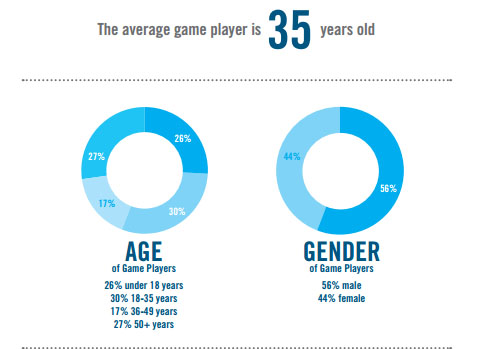
The average age of gamers has increased significantly from last year’s data, which found that the average age of a gamer was 31. What’s leading this change? Could be that mobile games are reaching a larger audience than in previous years.  Another thing to note is that percentage of female gamers has actually decreased this year; last year they made up 48% of the gaming population. This change could representative of the sample population, or it could reflect a change in certain marketing over the past year.

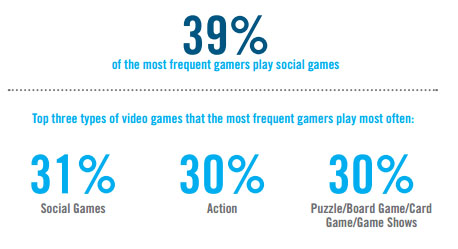
socialThe majority of gamers are social gamers. Gone are the days in which gaming was primarily done by yourself in a dingy basement that may or may not have mold on the ceiling; Now it’s done in the same basement, but with people playing with friends! That said, this makes sense: most major video games now have an online component to them. Only 4 of the top 20 best selling games last year didn’t have a major online component to them, and 3 of the 4 were aimed at children.what we playGames that connect people are on the rise and more than ever we are playing with people across the world. Online communities are now global networks with people working and playing together. You’re next best gaming partner could be a thousand miles away from you. However, I would be interested to know how the ESA defines a social game: Is Super Smash Brothers and social game because it features online play?

esrb

The gaming landscape is still one that is incredibly diverse in terms of themes and age levels. There’s a tend to lump the majority of games in as “mature and violent”, but the majority of video games still are considered family friendly. 11 of the top 20 best selling games last year were rated E or E10+.

parentsThe relationship between gaming and family is an ever changing one. Parents are learning how to incorporate and monitor the usage of gaming in their children’s lives. The percentage of parents that monitor the games and hours their children play video games is 91%, up from 87% last year. The influence of video games on children is something we’re gradually getting a better understanding on, so it make sense that year after year parents are becoming more involved in their childrens gaming habits.digitalvs

Lastly, for the first time in the history of video games, digital sales seem to have surpassed physical copies. Keep in mind this is for the industry as a whole (which includes both mobile and PC games), but it’s still an important milestone for the industry. As we discussed, the trend towards digital games raises question about the future of video games preservation. The number of mobile games and digital only games will only increase in the coming years, so you may want to rethink your physical copy library you’ve been creating over the years.

All together it’s an interesting year for video game demographics. We’re advancing towards a more inclusive and diverse video game population, but we’re still taking strides. As we see, it’s not always a one way street towards equal demographics, as the numbers and ratios of gamers will flucate over time.

In the upcoming weeks I hope to use all of this research to best come up with a picture of the the average gamer and evaluate what insight we can pull from understanding the typical gamer.

***Please keep in mind that this data is representative of a survey population and does not neccessarly represent the entire population of gamers. While it is probably the best research and data we have on the subject, a population of 4000 households  is still just a survey population attempting to make statements for a population that is increasingly changing and growing.

Useful Links:

ESA 2015 Essential Facts

ESA 2014 Essentail Facts

ESA’s Website

Final Fantasy XV Director: “An All-Male Party Makes Final Fantasy XV ‘More Approachable”

In a recent interview, Final Fantasy XV Director Hajime Tabata responded to questions of why the upcoming game features an all male cast for playable characters. His response already has the internet in uproar, but let’s look at it critically:

“Speaking honestly, an all-male party feels almost more approachable for players. Even the presence of one female in the group will change their behaviour, so that they’ll act differently. So to give the most natural feeling, to make them feel sincere and honest, having them all the same gender made sense in that way

Before we label Tabata the next coming of the anti-Christ (You meet that guy the first time around? He was a jerk!), we should probably get the whole story. Habata has already discussed how he wanted the game to feel like a round-trip with friends, and wanted the game’s theme to deal with male to male intimacy in ways that we hadn’t seen in games prior (No, not the male intimacy only dating sims can show). Let’s not dance around it: He’s trying to show a bromance between four different characters and to accurately create this bromance he’s excluding female characters because he thinks their presence would naturally change the dynamic of the group.

…He’s not wrong? This isn’t to say that a group of males can’t hang out with a female without having their friendships dramatically altered, but if your theme is male bonding and what males are like when females aren’t around then a female character certainly will have a dramatic effect on that theme. Funnily enough, the lack of female characters really hadn’t been that big of an issue with most gamers until Tabata made this statement, which can be taken some different ways.

Tabata further had to say:

The world might be ready to see the curtain lifted on what boys do when girls aren’t around, when they come out of the tent all prim and proper. That’s kind of the idea behind it… we think, male or female player, that everyone will feel a certain connection and bond with the four characters

…Hopefully what Tabata has been doing when girls aren’t around is PG and not strange and bizarre. He’s really trying a little too hard to justify something that is kind of a non-issue, which makes it seem like a bigger issue.

Ah damn, we have bigger problems with this game…

So, should we be outraged by the team excluding female characters and thinking that a female character would change the dynamic of a game with a theme of male bonding? Probably not. The Final Fantasy franchise is many things, but I wouldn’t call it a franchise that is particularly male dominated….Though its representation of females isn’t all that positive in parts (Seriously, what mechanics dress like that?). In the end, it’s a narrative driven game with a specific narrative that unfortunately doesn’t lead to female characters being incorporated into the gameplay. Unlike with games like Assassin’s Creed Unity, which purposefully chose not to include female characters despite the characters being customizable and blank, you can’t really fault a developer for wanting a specific narrative and creating characters that only fit that narrative.

We’ll have to wait and see until the game is released to judge for ourselves whether or not the exclusion of playable female character really does increase the male bonding dynamic between the characters.

Strong Museum (NY) Is Creating Video Game Hall of Fame

“Video games don’t belong in museums, that’s where we put old chairs and paintings of dead people” – no one ever.

The Strong Museum in New York, more commonly known as the national museum of play, is taking nominations for a video game hall of fame. Gamers across the world can go online and vote for which games they believe should be immortalized in the museum’s hall of fame. Before you go rushing to vote Battle Toads & Double Dragon as the most historically important video game of all time, you may want to know some background as to why they’re creating this hall of fame.

Why and how are they doing this? Well, as President and Chief Executive of the museum puts it:

“Electronic games have changed how people play, learn and connect with each other, including across boundaries of culture and geography”

That’s what we’ve been saying for year! Joking aside, it’s good to see video games get more of an academic and historical presence. The creation of a video game hall of fame is one step towards video games being properly preserved for future generations, which as we discussed in previous articles is a real issue in the community.

Games will be decided by a advisory committee and will inducted based on a set criteria. The criteria is as follows:

The World Video Game Hall of Fame recognizes electronic games that meet the following criteria: icon-status, the game is widely recognized and remembered; longevity, the game is more than a passing fad and has enjoyed popularity over time;geographical reach, the game meets the above criteria across international boundaries; and influence, the game has exerted significant influence on the design and development of other games, on other forms of entertainment, or on popular culture and society in general. (A game may be inducted on the basis of the last criterion without necessarily having met all of the first three.)

This means that hall of fame won’t just include the highest selling games of all times, but will take into consideration a game’s impact on the industry and society as a whole. Let’s try  and get some of those socially important games in there, like Joe & Mack (It’s a historical documentation about how cavemen loved women and hated dinosaurs). This is a big step for the medium, which is still relatively underrepresented in museums as a whole. In the next few years with Frisco’s first museum dedicated solely to video games and this creation of a hall of fame, we may see video games getting more historical and sociological coverage and representation than ever before.

What games, characters, or franchises would you put in the Video Game Hall of Fame?

You can read the entire press release here!