This Day in Gaming History: Nintendo’s Revolution

This is a new feature on the blog in which we look back at some of the important landmarks of video game history and explore how they changed the video game landscape.

gam

Today we take you back to the futuristic past of the year 2005 with the unveiling of Nintendo’s little rectangular console that would be a revolution in gaming.

IT’S THE WII

As crazy as it sounds, it’s been over a decade since Nintendo first revealed the Wii (Then called the Nintendo Revolution). Marty… we gotta go back to May 17th, 2005.

E3 2005 is in full swing, gamers are enjoying the amazing games like Resident Evil 4 at home, and the final Star Wars film will be in theaters in only a few days (YOU’VE FOOLED US AGAIN LUCAS!). Sony and Microsoft have already announced their next generations consoles the day before and Nintendo is the only major conference left. 30 minutes into the conference Mr.Iwata takes the stage and proclaims “We gave you DS, a new Game Boy, and new games to play on them. And now, you say you want a Revolution? Well, we’ve got one”,  to which he pulls out the console. The next few months were filled with speculation over hardware and what to expect on the little console from Nintendo (Spoiler: Some good games, but a lot of waggle).

A snippet from Nintendo’s press release immediately after the conference:

NINTENDO’S COMPACT CONSOLE WILL TURN THE WORLD OF GAMING ON ITS SIDE

New System will be Forward-Thinking, Yet Backward Compatible

LOS ANGELES, May 17, 2005 – Each generation of video game consoles builds on the past to set new standards for the future. As the company with the strongest heritage of innovation, Nintendo redefines expectations for all next-gen systems by employing a wide-ranging strategy to attract more kinds of gamers to more kinds of games. When Nintendo’s new console, code-named Revolution, arrives in 2006, everyone will discover the meaning of All-Access Gaming.

“We will show the world what a next-gen system can be. Revolution marries the strongest heritage of innovation to the future of gaming,” says Nintendo President Satoru Iwata. “With backward compatibility and the ‘virtual console’ concept, the stylish, compact body provides maximum gaming power. It will not only take home entertainment into another dimension by expanding the definition of video games, but it also will give you access to the great history of gaming.”

“Our next console proves small in size but big on ideas,” says Reggie Fils-Aime, Nintendo of America’s executive vice president of sales & marketing. “We’re throwing open the doors of gaming to wider audiences, from casual players to hard-core gamers who live for the thrill of defeating an endless army of wireless opponents.”

One omission you’ll probably notice about the press release is the lack of comments talking about the Wii’s motion controls, which weren’t actually detailed until sometime after the console’s initial announcement. It wasn’t until The Toyko Gameshow 2005 that Nintendo announced the hallmark of the Wii, it’s unique motion controls via its sensor bar and remote like controller. At E3 2006, a year after the console’s announcement, Nintendo finally announced the change from Nintendo Revolution to Nintendo Wii, which disappointed some gamers in the end.

So why do we care? The Nintendo Wii was and is still Nintendo’s highest selling video game console to date (2nd only to Sony’s PS2) and is the first console to popularize motion controls. Today, many will brush off the Wii as passing fad or a phenomenon charged by popularity, but it really was a drastic change in the gaming landscape from one of the oldest and most prominent names in gaming. It radically changed how the company viewed gaming and what they prioritized in making their consoles. Sony and Microsoft’s secondary motion control efforts are proof of concept for Nintendo and proof that Nintendo really did create a spark.

Beyond that, the Wii introduced (or reintroduced) many to video games and expanded the community of gamer to be more inclusive than ever. Your mom was playing the Wii, your grandma was playing the Wii, your high school teacher could school your butt at Wii Golf. It was in every sense of the word a phenomenon.  Wii Sports, the console bundled in game, is the best selling console game of all time and many of the console’s titles went on to remarkable success. Nintendo showed that you didn’t have to be the most powerful console on the market to be the most successful; sometimes innovation trump hardware.

Did Nintendo follow through on a revolution? In some ways yes. The Wii was a momentous video game console that will go down in history as a game changer, but certainly it didn’t have the lasting effect Nintendo would have hoped for. Nintendo squandered some of the momentum they created by tacking on needless peripherals and control options, but many games at their core benefited from the added on motion controls; games like Super Mario Galaxy, Legend of Zelda Skyward Sword and Metroid Prime 3 are shinning examples of how beloved franchises can benefit from innovation.  Of course, their next move may have been their worst: the Wii U has suffered from some of the same pitfalls the Wii befell; lack of third party support, lack of a pleasing online structure, lack of new IPs, and a poor marketing presence are some of the console’s blemishes. Still, we can only look back on the Wii’s announcement as a door opening in the video game industry. Like it or not, the Wii was something special.

What do you think about the Wii? Was it just a waggle machine or was it really an innovation from Nintendo?

Psychologist Philip Zimbardo “Video Games Have Sabotaged What It Means To Be Male “

Fairly well know psychologist Philip Zimbardo, famously known for the Stanford Prison Experiments, has been making the rounds recently discussing the findings in his new book “Man (Dis)connected: How Technology Has Sabotaged What It Means To Be Male”I haven’t had the time to read his book, but it’s clear that he’s making some bold claims about how video games are changing the social development of today’s youths, specifically boys.

The Guardian has a pretty well done interview with Zimbardo, so I’ll be focusing on their piece rather than his actual book (I’m poor and too busy to with a full time job/lazy/ don’t really want to support him) On why we’re seeing boys retreat into cyberspace and video games more than their female peers:

“Boys have never been self-reflective. Boys are focused on doing and acting, girls are more focused on being and feeling. The new video-game world encourages doing and acting and not really
thinking. Video games are not so attractive to girls.”

That’s a pretty hefty generalization, albeit not completely untrue. Biologically boys have some proclivity to being less “self reflective” and focused on “action and doing”, but a lot of it has to do with a child’s socialization.  The way we treat little boys and girls, in addition to the images we show to them of what it means to be a boy or a girl has just as much to do with a child’s habits as their biological make up.  Additionally, just the way education is presented to boys and girls is strikingly different; young girls are socialized to hold education in a higher esteem than young boys. Obviously Zimbardo is making this statements to make a generalization about the current population and is probably somewhat representing the population as a whole. That said, if we as a society change the way we socialize young boys and girls then maybe that statement will begin to lose truth.

Secondly, no. Video games are attractive to both young boys and girls. If anything, video games are now more attractive to both males and females than ever before. More and more the gender divide in the gaming community is becoming less unequal. Though it still has a long way to go, it’s clear that young girls enjoy playing games just like young boys; video games have historically only been taught to be  “boy thing”, big impart due to marketing and parenting. I don’t agree with that statement.

The driving cause Zimbardo places in his theory of boys becoming addicted to porn, video games, and Ritalin is lack of a father figure in the household.  The lack of a father, or any second parental figure, obviously changes the dynamic of any household. That’s one less parent to provide affection, attention, and income.  All of these factors lead to scenarios in which it’s harder for a child to create more stable relationships and social skills. For example, children from a one parent household are less likely to engage in extracurricular activity because their parent has less time to take their children to the activities or have the money to spend on the activity. This lack of extracurricular activity leads to less chances for socialization and more towards being motivated to seek electronic alternatives. If anything, video game and porn addiction are a symptom of a greater issue. However, these are things that Zimbardo probably already knows and perhaps even addresses in his book.

My biggest issue, and I say issue sparingly as obviously I haven’t read his book, is that video games once again are seemingly taking the blame for something else that’s at hand. Video games, like any other media, can be an outlet for many problems and not necessarily the cause of those problems. Zimbardo doesn’t sound like he’s arguing that, but when you make claims like “Technology Has Sabotaged What It Means To Be Male” it puts the blame on the object, rather than the underlying causes that are resulting in the object overuse or misuse. Yes, more advance technology give easier means of escaping reality and disconnect, but the reason why people are desiring to disconnect and escape is the issue at hand.  Granted, Zimbardo expresses desires for games that better promote social relationships and cooperation, but he’s gotta be better at making a enemy out of something that isn’t there.  I will say this: the book sounds more grounded than it’s shocking title.  Zimbardo is a smart guy, albeit one with questionable tactics, and he has to know hyperboles aren’t helping anyone. Though shock and awe seem to be his style…

Who is The Average Gamer?

With the 2015 Essential Facts about the Computer and Video Game Industry recently explored, I thought it would be interesting to use all of the data to create a picture of who the average gamer is.

How are constructing this picture? Using the Data that the ESA gathered in their annual report on the demographics of the video game community we can pull it all together to create a hypothetical person. Granted, this person does not represent the entirety of the video game industry (in fact they probably won’t represent a lot of gamers), but it will convey the most typical gamer.

Why is This Being Done? There’s a lot of application to this kind of data. By understanding who the “average gamer” is, we can determine who the industry is primarily catered towards. While we’re making strides in being a more inclusive industry, the video game industry is still one of marketing and product creation with the average consumer in mind. With an understanding of who their target audience is, we can better understand how to expand that audience.

Views in the past. It goes without saying that one’s idea of the average gamer is something that has changed quite significantly in recent time. Years ago video games were thought to be primarily a children’s activity, but we’re discovering that this is no longer the case. The industry is no longer one dominated by young boys; we’re seeing that the industry is diversifying more and more as we go on. Thus, it’s important to reevaluate how he picture the average gamer:

Who is the average gamer?

We’re creating a person; we’ll need a name for this person. Let’s call this person Avery (Yeah, it’s a little on the nose..) Who is Avery? How old is Avery? Is Avery a male or female? What games does Avery play? Who is Avery playing with? How much time does Avery spend playing video games? LET’S FIND OUT WHO THIS AVERY IS.

Avery is a 35 year old male. In Avery’s household, there is one other person in the house that plays video games. The household owns at least one dedicated video game console, but Avery also plays a good amount of his video games on his PC. Avery isn’t new to video games, in fact Avery has been playing video games for 13 years. Avery plays games in moderation; he actually only plays about 3-4 hours of gaming a week. However, the usage of his console doesn’t end there; Avery uses his console to watch movies, watch TV and other forms of media. When he does get sometime to play games, he’s playing mostly social games, action games, and puzzle/card/board games. He plays with others either online or in person, but when he does it’s primarily with his friends. He spends a fair amount on video games per year, as he believes that video games are a good value for his money in comparison to other forms of media (dvds, theaters, etc.) Recently Avery has made a switch to buying more games digitally than physically. Last year, some of the games Avery most likely played were Call of Duty: Advanced Warfare, Madden, and the Sims 4.  Video games are becoming a greater and greater part of Avery’s everyday life; the time he plays per week are increasing every year and the amount of money he spends on games is also increasing. How long will Avery remain the average gamer? That remains to be seen.

If Avery was a parent:

Avery is knowledgeable about his children’s video game usage. He’s aware of the the ESRB ratings of each game and monitors the content of the game his kids are playing. He believes that its the parent’s responsibility to limit the amount of time their kids are playing games, surfing the internet, and watching TV. Avery believes video games are a positive part of his kids live’s, and will even play with his kids from time to time.

Admissions:

1) Race statistics on the video game industry seemingly don’t exist, or at least there isn’t a reputable source that I could find. Many studies examine racial representation and racial preference in video games, but not necessarily the demographics on the industry as a whole. That said, it’s not unreasonable to assume that the racial make-up of the American video game industry isn’t that far off from the general make-up of the United State’s demographics. This leads me to assume that the average American gamer is most likely Caucasian.

2) This portrait of the average gamer is representative of the United States, and may not be reflective of  other communities. Obviously we can assume that some of the statistics will carry over (Male dominated, for example, is one that is most likely true of most communities)

3) I’m only working with the research at hand. Unfortunately I’m not able to conduct my own research to narrow down other aspects of this portrait, and as a result we’re still left with a lot of mysteries about the average game.

So there you have it, a partial look at who the average gamer is. I hope this has been somewhat insightful and helpful for anyone trying to gather a better understanding on the video game industry. If not….eh, I tried.

ESA 2015 Essential Facts About The Computer & Video Game Industry

It’s that time of year again when the Entertainment Software Association (ESA) release their  yearly findings on the demographics and make up of the video game industry. The ESA is the foremost gatherer of this type of data and this yearly survey is the most in-depth of its kind. This is important stuff and extremely useful for anyone seeking data on video games and their communities.

Now you may be asking: “Who is this ESA and why should I believe the data these dweebs are spouting?” Well, 90s Bully child, who better to tell you who the ESA than the ESA themselves:

The Entertainment Software Association (ESA) conducts business and consumer research, and provides analysis and advocacy on issues like global content protection, intellectual property, technology, e-commerce and the First Amendment in support of interactive software publishers. ESA owns and operates E3 and represents video game industry interests on federal and state levels.

Yeah, so they’re those people…Them.  A better description would be that they’re a organization that gathers pertinent information to better regulate content within the industry by partnering with a lot of the biggest names in the industry. In addition to the ESRB, the group that decides Manhunt is a more mature game than Pikmin (YOU’RE PLAYING WITH LIVES IN BOTH GAMES), they have programs that give scholarships to youths, a board that acknowledges achievements in the industry, and a group of advocates that promote taking action in support of video games. All in all, they’re a pretty cool organization that is making a positive influence on the video game industry.

Enough of that jibber-jaber, let’s get to the data!

Genderage

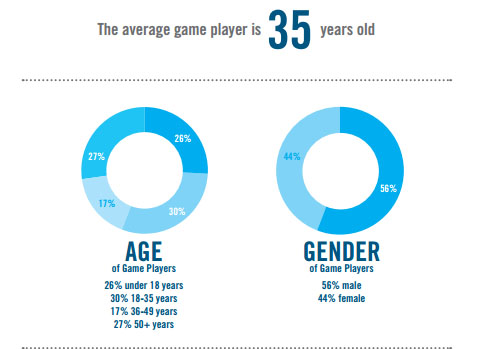
The average age of gamers has increased significantly from last year’s data, which found that the average age of a gamer was 31. What’s leading this change? Could be that mobile games are reaching a larger audience than in previous years.  Another thing to note is that percentage of female gamers has actually decreased this year; last year they made up 48% of the gaming population. This change could representative of the sample population, or it could reflect a change in certain marketing over the past year.

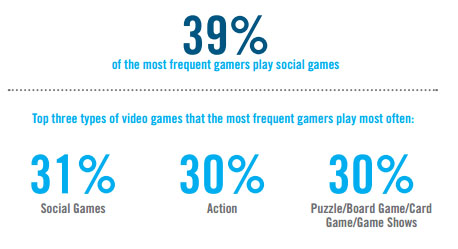
socialThe majority of gamers are social gamers. Gone are the days in which gaming was primarily done by yourself in a dingy basement that may or may not have mold on the ceiling; Now it’s done in the same basement, but with people playing with friends! That said, this makes sense: most major video games now have an online component to them. Only 4 of the top 20 best selling games last year didn’t have a major online component to them, and 3 of the 4 were aimed at children.what we playGames that connect people are on the rise and more than ever we are playing with people across the world. Online communities are now global networks with people working and playing together. You’re next best gaming partner could be a thousand miles away from you. However, I would be interested to know how the ESA defines a social game: Is Super Smash Brothers and social game because it features online play?

esrb

The gaming landscape is still one that is incredibly diverse in terms of themes and age levels. There’s a tend to lump the majority of games in as “mature and violent”, but the majority of video games still are considered family friendly. 11 of the top 20 best selling games last year were rated E or E10+.

parentsThe relationship between gaming and family is an ever changing one. Parents are learning how to incorporate and monitor the usage of gaming in their children’s lives. The percentage of parents that monitor the games and hours their children play video games is 91%, up from 87% last year. The influence of video games on children is something we’re gradually getting a better understanding on, so it make sense that year after year parents are becoming more involved in their childrens gaming habits.digitalvs

Lastly, for the first time in the history of video games, digital sales seem to have surpassed physical copies. Keep in mind this is for the industry as a whole (which includes both mobile and PC games), but it’s still an important milestone for the industry. As we discussed, the trend towards digital games raises question about the future of video games preservation. The number of mobile games and digital only games will only increase in the coming years, so you may want to rethink your physical copy library you’ve been creating over the years.

All together it’s an interesting year for video game demographics. We’re advancing towards a more inclusive and diverse video game population, but we’re still taking strides. As we see, it’s not always a one way street towards equal demographics, as the numbers and ratios of gamers will flucate over time.

In the upcoming weeks I hope to use all of this research to best come up with a picture of the the average gamer and evaluate what insight we can pull from understanding the typical gamer.

***Please keep in mind that this data is representative of a survey population and does not neccessarly represent the entire population of gamers. While it is probably the best research and data we have on the subject, a population of 4000 households  is still just a survey population attempting to make statements for a population that is increasingly changing and growing.

Useful Links:

ESA 2015 Essential Facts

ESA 2014 Essentail Facts

ESA’s Website

Study Shows Link Between Excessive Gaming and Behavioral Issues

SHOCKING HEADLINE: A new study posted in  the Journal of Psychology of Popular Media Culture finds a correlation between playing games for an extended amount of time and behavioral issues in teenagers. KEEP THAT POKEMON AWAY FROM THEM TWEENS, OR YOU’RE GONNA GET TROUBLE!

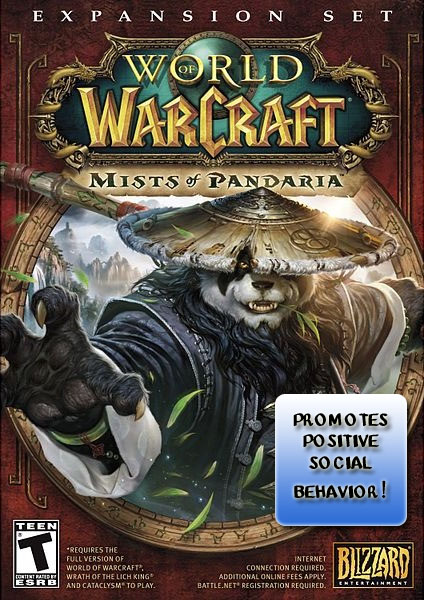
The new study posted in  the Journal of Psychology of Popular Media Culture  evaluated the amount of time spent on video games per day and the behavior habits of teenage students in class. The Washington Post has a pretty good break down of the study in general, so check it out here. As you might expect, teens who played more than 2 hours a night (on average) exhibited more behavioral issues, such as hyperactivity, and were less interested in their academics. The sun is also hot, and Mario sometimes jump (SPOIIILLLEERRRR).  Furthermore, the study found that gamers who played solitary video games  showed less of these behavioral and academic problems than those who played competitive online games. However, teenagers who played online social games were less likely to exhibit social problems and were found to be more emotionally stable. PUT THAT ON THE BOX BLIZZARD!

Untitled-1

I apologize if I sound cynical about the first half of the study, but this form of study is one that we’ve seen several times in the past few years.  It’s correlation without causation. It’s easy to find a common thread in video games between respondents that are hyperactive and young because it’s an easy target. 10 years ago similar studies were done to say that internet use is leading to behavioral issues, 30 years ago it was TV corrupting our kids, and 60 years ago it was too much Radio leading kids astray (NPR led me to satanism).  It’s not to say that video game consumption isn’t an issue, but it’s a outlet for other isss. We have a habit of demonizing whatever media is popular among youths as corrupting, which in this era is video games.

That said, the study is one step in understanding how video games effect our lives, which is obviously something we like here on the blog. It may not be a drastic leap forward, but perhaps it will pave the way for future research evaluating how video games lead to specific social behaviors. A step is still a step, right? We’ll get there one day…

New Study Shows Benefits of Narrative in Video Games

Coming out of the University of Innsbruck  and Albert Ludwigs University of Freiburg, we have some research that probably won’t set the world on fire, but is interesting nonetheless.  The study looks at the benefits of narration in video games on the players experience and satisfaction, in addition to the benefits towards theory of mind (We’ll talk about what that is a little later).  It’s a pretty jargon heavy and technically written piece of research, but it’s worth a read if you’re interested in how a narrative can change a player’s experience.

You may be saying: “Hey! That sounds pretty obvious you dolt!”. I would first ask you to not call me a dolt (You know how that makes me feel…) and secondly I would say it’s a little more complicated than it sounds. Essentially the researchers found that narrative games create immersion that allows for players to better develop a sense of understanding towards the thoughts and beliefs of others (via those of in-game characters), in addition to finding that narratives in game increases satisfaction in players. The finding towards theory of mind (which I terribly boiled down above)  are small, but beneficial. The uses for such benefits could be used in future practices with an example being in working with kids with social development issues.

Is that Mario or a playboy bunny…?

I told you it wouldn’t set the world on fire with fascination. Hey, not all research studies can be exciting pieces that reveal to you that all gamers have a slight sexual attraction to plumbers because of Super Mario Land 2**** (Specifically that game, for whatever reason)

**** Research is in the process. Please don’t steal my brilliant idea

Update – EFF: “Videogame Publishers: No Preserving Abandoned Games”

This week the Electronic Frontier Foundation updated followers on their on-going crusade to fight for the rights of gamers and communities looking to keep their favorite games and communities going after publishers shut down servers and means to access said games.

We brought up this battle awhile ago, at it seems that the EFF’s fight has only been met with stark resistance from the publishers, specifically the Entertainment Software Association. This blog like both the EFF and the ESA, as they’re both doing some great things on the front of video game struggles and research, so it’s  unfortunate that they haven’t found common ground.

Let’s go over their update:

The EFF recently petitioned for “legal protection to game enthusiasts, museums, and academics who preserve older video games and keep them playable”. Specifically, they’re seeking exemption in certain cases from the Digital Millennium Copyright Act’s anti-circumvention provisions.  Their petition has been strongly opposed by the ESA, whom is arguing that any exception will send a statement to would be hackers that some forms of piracy is lawful. Damn pirates, always wanting to try do something ridiculous like play the games they bought online after they’ve been abandoned. What a bunch of jerkos!

This issue is an important one for gamers and researchers seeking to preserve gaming history. As we approach a time in which video games are slowly making their ways into museums and dedicated  channels, such a blanket stance against communities trying to keep certain games from falling into obscurity is counter-productive and harmful to the industry. As it’s been mentioned on this blog before, certain games only exist playable in some form because of the efforts of hackers and pirates; without, it’s unknown whether we’d still have these games.

This isn’t a closed case, and the EFF is still fighting for the rights of these groups. I’ll try and update this and the case goes on,

Final Fantasy XV Director: “An All-Male Party Makes Final Fantasy XV ‘More Approachable”

In a recent interview, Final Fantasy XV Director Hajime Tabata responded to questions of why the upcoming game features an all male cast for playable characters. His response already has the internet in uproar, but let’s look at it critically:

“Speaking honestly, an all-male party feels almost more approachable for players. Even the presence of one female in the group will change their behaviour, so that they’ll act differently. So to give the most natural feeling, to make them feel sincere and honest, having them all the same gender made sense in that way

Before we label Tabata the next coming of the anti-Christ (You meet that guy the first time around? He was a jerk!), we should probably get the whole story. Habata has already discussed how he wanted the game to feel like a round-trip with friends, and wanted the game’s theme to deal with male to male intimacy in ways that we hadn’t seen in games prior (No, not the male intimacy only dating sims can show). Let’s not dance around it: He’s trying to show a bromance between four different characters and to accurately create this bromance he’s excluding female characters because he thinks their presence would naturally change the dynamic of the group.

…He’s not wrong? This isn’t to say that a group of males can’t hang out with a female without having their friendships dramatically altered, but if your theme is male bonding and what males are like when females aren’t around then a female character certainly will have a dramatic effect on that theme. Funnily enough, the lack of female characters really hadn’t been that big of an issue with most gamers until Tabata made this statement, which can be taken some different ways.

Tabata further had to say:

The world might be ready to see the curtain lifted on what boys do when girls aren’t around, when they come out of the tent all prim and proper. That’s kind of the idea behind it… we think, male or female player, that everyone will feel a certain connection and bond with the four characters

…Hopefully what Tabata has been doing when girls aren’t around is PG and not strange and bizarre. He’s really trying a little too hard to justify something that is kind of a non-issue, which makes it seem like a bigger issue.

Ah damn, we have bigger problems with this game…

So, should we be outraged by the team excluding female characters and thinking that a female character would change the dynamic of a game with a theme of male bonding? Probably not. The Final Fantasy franchise is many things, but I wouldn’t call it a franchise that is particularly male dominated….Though its representation of females isn’t all that positive in parts (Seriously, what mechanics dress like that?). In the end, it’s a narrative driven game with a specific narrative that unfortunately doesn’t lead to female characters being incorporated into the gameplay. Unlike with games like Assassin’s Creed Unity, which purposefully chose not to include female characters despite the characters being customizable and blank, you can’t really fault a developer for wanting a specific narrative and creating characters that only fit that narrative.

We’ll have to wait and see until the game is released to judge for ourselves whether or not the exclusion of playable female character really does increase the male bonding dynamic between the characters.

Nintendo Celebrates Women’s History Month

Nintendo’s been making some headlines this week with their announcement that they’ll soon be entering the smartphone app world, but they’ve also been hard at work highlighting some of their memorable female characters in honor of Women’s History month.

Here are the characters they highlighted:

In The Legend of Zelda: The Wind Waker HD, Princess Zelda was actually a tough and spunky captain of a ragtag group of pirates. Tetra saves Link from Ganondorf’s clutches, and later helps Link defeat Ganondorf for good to save the world.


Toadette is a recurring Toad character in the Mario series. These days, she’s a plucky treasure-hunter in Captain Toad: Treasure Tracker, who puts on a brave face to find rare goodies and save Captain Toad from the monstrous and greedy bird, Wingo.


Bayonetta is a sassy and incredibly stylish witch with pistol-stilettos and a vendetta against the armies of angels and demons that hunt her. She’s a force to be reckoned with, an ally to her best friend and fellow witch Jeanne and doesn’t take flak from anybody.

Rosalina is an interstellar observer, protector of the Lumas and friend to Mario in Super Mario Galaxy. She is mother to the Lumas, who are little star-like creatures capable of becoming new galaxies!

Lucina is an unwavering warrior with a strong sense of justice and commitment to her family. Her power, determination and wisdom gained from watching the destruction of her world are priceless strengths as one of Fire Emblem Awakening’s many playable female protagonists.

Samus Aran shocked the video game world at the end of the original Metroid game by revealing her gender and changing the way we think about video game characters in the process. Video game protagonists need not be male in order to be strong. Samus is a space bounty hunter in an armored suit, outfitted with a powerful blaster on the arm and extreme heat resistance.

Bombette is a Bob-omb who joins Mario on his quest in the original Paper Mario for the Nintendo 64. As a member of Mario’s diverse team of fighters, she has an explosive fighting style and isn’t afraid to get physical with her body slam and powerful bomb attacks. – 

Let’s not lie about it: Nintendo hasn’t exactly been the most forward thinking developer in their history, but they have made some strides to being a more inclusive and representative developer in the last couple of years. That said, some odd choices on some of the characters they chose; Bayonetta isn’t a Nintendo character and Bombette hasn’t seen the light of day since the year 2000. But, something is better than nothing…Right?

Strong Museum (NY) Is Creating Video Game Hall of Fame

“Video games don’t belong in museums, that’s where we put old chairs and paintings of dead people” – no one ever.

The Strong Museum in New York, more commonly known as the national museum of play, is taking nominations for a video game hall of fame. Gamers across the world can go online and vote for which games they believe should be immortalized in the museum’s hall of fame. Before you go rushing to vote Battle Toads & Double Dragon as the most historically important video game of all time, you may want to know some background as to why they’re creating this hall of fame.

Why and how are they doing this? Well, as President and Chief Executive of the museum puts it:

“Electronic games have changed how people play, learn and connect with each other, including across boundaries of culture and geography”

That’s what we’ve been saying for year! Joking aside, it’s good to see video games get more of an academic and historical presence. The creation of a video game hall of fame is one step towards video games being properly preserved for future generations, which as we discussed in previous articles is a real issue in the community.

Games will be decided by a advisory committee and will inducted based on a set criteria. The criteria is as follows:

The World Video Game Hall of Fame recognizes electronic games that meet the following criteria: icon-status, the game is widely recognized and remembered; longevity, the game is more than a passing fad and has enjoyed popularity over time;geographical reach, the game meets the above criteria across international boundaries; and influence, the game has exerted significant influence on the design and development of other games, on other forms of entertainment, or on popular culture and society in general. (A game may be inducted on the basis of the last criterion without necessarily having met all of the first three.)

This means that hall of fame won’t just include the highest selling games of all times, but will take into consideration a game’s impact on the industry and society as a whole. Let’s try  and get some of those socially important games in there, like Joe & Mack (It’s a historical documentation about how cavemen loved women and hated dinosaurs). This is a big step for the medium, which is still relatively underrepresented in museums as a whole. In the next few years with Frisco’s first museum dedicated solely to video games and this creation of a hall of fame, we may see video games getting more historical and sociological coverage and representation than ever before.

What games, characters, or franchises would you put in the Video Game Hall of Fame?

You can read the entire press release here!